What Is SEO Outsourcing and Why It Matters for Your Business

What Is SEO Outsourcing and Why It Matters for Your Business

Running a business today is not easy. You have to manage sales, customers, marketing, and so much more. On top of that, you also need your website to show up on Google. That’s where SEO comes in.

But here’s the truth: SEO takes time, skill, and regular effort. Many business owners start doing it themselves but soon feel confused or tired. That’s when SEO outsourcing becomes a smart choice. In this blog, you’ll understand what SEO outsourcing really means, why businesses are choosing it, and how it can help you grow faster without stress.

What Is SEO Outsourcing?

SEO outsourcing means hiring an external company or team to handle your website’s search engine optimization instead of doing it yourself. This team works on improving your website so it ranks higher on Google and other search engines.

seo

In simple words:
1. You focus on your business.
2.  Experts handle your SEO.

These experts can be a digital marketing agency, such as Bizfist IT Solutions, or freelance SEO professionals.

What Services Are Included in SEO Outsourcing?

When you outsource SEO, you get a complete package of services that help your website grow.

1. Keyword Research

Finding the best keywords people are searching for, like:

  • SEO outsourcing services
  • affordable SEO services
  • digital marketing agency
  • SEO for small business

2. On-Page SEO

Optimizing your website pages:

  • Titles and headings
  • Meta descriptions
  • Content improvement
  • Internal linking

3. Technical SEO

Making sure your website works smoothly:

  • Fast loading speed
  • Mobile-friendly design
  • Fixing errors

4. Content Creation

Writing blogs and website content that people want to read.

5. Link Building

Earning backlinks from other sites to make your website more reliable.

6. SEO Reporting

Tracking results and showing how your rankings improve over time.

Why Businesses Are Choosing SEO Outsourcing

Many businesses, especially small and medium ones, are now outsourcing SEO. Let’s understand why.

1. Saves Time

SEO is not a one-time task. It needs regular updates, content, and monitoring. Outsourcing helps you save hours every week.

2. Access to Experts

SEO experts already know what works. They stay up to date with Google changes, so you don’t have to learn everything yourself.

3. Cost-Effective

Hiring a full in-house SEO team can be expensive. Outsourcing gives you expert services at a lower cost.

4. Faster Results

Experienced teams can quickly find problems and fix them. This helps your website grow faster.

5. Focus on Core Business

Instead of worrying about rankings, you can focus on your customers and business growth.

How SEO Outsourcing Helps Your Business Grow

Outsourcing SEO is not just about rankings. It brings real business benefits.

More Website Traffic

When your website ranks higher, more people visit it.

Better Leads and Sales

Right SEO brings the right audience, people who are already searching for your services.

Strong Online Presence

Your brand becomes more visible and gains trust online.

Long-Term Growth

SEO is not a quick fix. It builds a strong foundation that keeps bringing results over time.

When Should You Outsource SEO?

You should consider SEO outsourcing if:

  • Your website is not getting traffic
  • You don’t understand SEO properly
  • You don’t have time to manage it
  • Your competitors are ranking higher
  • You want faster growth

If any of these sound familiar, outsourcing can be the right step.

Common Mistakes to Avoid While Outsourcing SEO

Outsourcing is helpful, but only if done right. Avoid these mistakes:

1. Choosing Only Cheap Services

Low-cost SEO often means poor quality. Always check experience and results.

2. Expecting Instant Results

SEO takes time, so stay patient and focus on long-term results.

3. Not Checking Reports

Always track progress and understand what work is being done.

4. Ignoring Communication

Stay connected with your SEO team and ask questions when needed.

How to Choose the Right SEO Partner

Choosing the right SEO company is very important. Here’s what you should look for:

  • Proven experience in SEO services
  • Clear strategy and planning
  • Regular updates and reports
  • Transparent pricing
  • Good communication

A reliable company like Bizfist IT Solutions focuses on real results, not just promises.

What Happens After You Start SEO Outsourcing?

Once you start SEO outsourcing, the process usually follows a clear step-by-step approach. Understanding this helps you stay confident and know what to expect.

  1. First, the SEO team will do a complete website audit. They check your current rankings, website issues, and competitor performance. This gives them a clear starting point.

  2. Next, they create a strategy based on your business goals. This includes keyword planning, content ideas, and technical improvements needed for your website.

  3. After that, the actual work begins. This includes optimizing your website, creating content, and building backlinks. All of this is done step by step to improve your rankings.

  4. You will also receive regular reports. These reports show how your website is performing, what improvements are happening, and how your traffic is growing.

  5. Over time, you will start seeing better rankings, more visitors, and improved leads. SEO is a gradual process, but with the right team, the results are long-lasting and reliable.

Final Thoughts

You don’t have to do everything on your own to grow your business. Smart business owners know when to get help. SEO outsourcing is not about losing control; it’s about gaining expert support.

When the right people handle your SEO, you don’t just get rankings, you get real growth, more customers, and a stronger future for your business.

Sometimes, the best decision is not working harder but working smarter. And in today’s digital world, visibility is everything. If your business is not showing up online, you’re missing chances every single day. SEO outsourcing allows you to stay visible, relevant, and competitive without stretching yourself too thin. It’s not just a service; it’s a long-term partnership that helps your business move forward with clarity and confidence.

FAQs

SEO outsourcing means hiring an outside team or company to handle your website’s SEO work. Instead of learning everything yourself, experts take care of improving your rankings, fixing website issues, and bringing more traffic. This allows you to focus on running your business while professionals manage your online growth.

Yes, SEO outsourcing is especially helpful for small businesses. Most small businesses don’t have the time or budget to build a full in-house SEO team. By outsourcing, they can get expert services at a lower cost and compete with bigger brands online. It helps them grow faster without feeling overwhelmed.

The cost of SEO outsourcing depends on your business needs, industry competition, and the services included. Some companies offer affordable monthly plans, while others provide customized packages. Instead of looking for the cheapest option, it’s better to focus on value and results because good SEO is an investment, not an expense.

SEO is a long-term strategy, so results don’t happen overnight. Most businesses start seeing noticeable improvements in 3 to 6 months. However, the timeline can vary depending on competition, website condition, and strategy. Consistency and patience are key to getting strong and lasting results.

Yes, you can learn and do SEO on your own, especially if you have time and interest. But SEO involves many technical and creative tasks like keyword research, content writing, and link building. Without experience, it can feel confusing and slow. Outsourcing helps you get better results faster with expert guidance.

The main risk is choosing the wrong SEO provider. Some companies use outdated or harmful techniques that can damage your website rankings. That’s why it’s important to work with a trusted and transparent SEO agency that follows proper methods and gives regular updates.

Before hiring, you should ask about their experience, past results, and the strategies they use. Also, ask how they track progress and how often they provide reports. Clear communication and transparency are very important, so you always know what work is being done on your website.

No genuine SEO company can guarantee the #1 position on Google because rankings depend on many factors, including competition and algorithm updates. However, a good SEO team can improve your visibility, increase traffic, and help you reach the right audience over time with the right strategy.

How to Fix SEO Issues That Affect Your Website Ranking

How to Fix SEO Issues That Affect Your Website Ranking

Ranking on Google is essential for online success, but many websites struggle due to hidden SEO issues. You may have a well-designed website, great services, and valuable content, yet still not get enough traffic. This usually happens when important SEO elements are not properly optimized.

SEO (Search Engine Optimization) helps your website appear in search results and reach the right audience. If your SEO is not working correctly, your website remains invisible while your competitors gain traffic and leads. The good news is that most SEO issues can be identified and fixed with the right approach.

In this blog, we will share simple and practical ways to fix SEO issues that affect your website ranking. Whether you are working with an SEO company in Surrey, an SEO consultant, or managing SEO on your own, this guide will help you understand everything clearly and improve your website’s performance.

website ranking

What Are SEO Issues

SEO issues are problems that stop your website from ranking well on search engines like Google.

These issues can be related to:

  1. Website speed
  2. Content quality
  3. Technical errors
  4. Missing keywords
  5. Poor user experience

Even small mistakes can lower your ranking. That is why doing a proper website audit and technical SEO audit is very important.

Effective Solutions to Fix SEO Issues and Improve Rankings

1. Start With a Complete Website Audit

Before making any changes, you need to understand what is wrong. A website audit gives you a clear view of your website’s performance.

It helps you:

  1. Identify errors on your site
  2. Check overall performance
  3. Find weak areas

A professional SEO agency or SEO consultant always begins with this step.

What to check in an audit:

  1. Broken links
  2. Slow-loading pages
  3. Missing meta tags
  4. Duplicate content
  5. Mobile responsiveness

This step builds the foundation for all improvements.

2. Use Google Search Console for Better SEO Insights

Without proper monitoring, you may miss important SEO issues. Google Search Console helps you see how your website is performing on search engines.

Google Search Console helps you track:

  1. Indexing issues
  2. Keyword performance
  3. Website visibility
  4. Technical errors

Why it matters:

  1. Shows how Google views your website
  2. Helps fix crawl and indexing problems
  3. Improves your overall SEO strategy

What to monitor:

  1. Coverage errors (pages not indexed)
  2. Search queries driving traffic
  3. Click-through rate (CTR)
  4. Mobile usability issues 

3. Fix Technical SEO Problems

Technical SEO builds a strong website. If it is weak, your rankings will suffer. A technical SEO audit helps find hidden problems.

a) Improve Website Speed

Slow websites lead to higher bounce rates.

Solutions:

  1. Compress images
  2. Use fast hosting
  3. Minimize unnecessary code


b) Make Your Website Mobile-Friendly

Most users browse on mobile devices.

Solutions:

  1. Use responsive design
  2. Test your website on different screen sizes


c) Fix Broken Links

Broken links negatively affect user experience and SEO.

Solution:

  1. Regularly check and update all links


d) Add an XML Sitemap

Search engines need a sitemap to understand your website structure.

Solution:

  1. Create and submit an XML sitemap

A provider offering SEO services in Surrey can handle these technical improvements efficiently.

4. Improve Your SEO Content

Content plays a major role in search success. Weak content can limit your visibility.

Good SEO content should be:

  1. Easy to read
  2. Clear and helpful
  3. Keyword-optimized (naturally)
  4. Focused on user intent

Common mistakes to avoid:

  1. Copy-paste content
  2. Keyword stuffing
  3. Very short or unclear articles

How to improve:

  1. Write for users, not just search engines
  2. Use simple language
  3. Add proper headings and structure
  4. Update old content regularly

A strong SEO agency always prioritizes content quality.

5. Use Keywords the Right Way

Keywords help search engines understand your content. However, incorrect usage can harm your rankings.

Your target keywords:

  • seo company in Surrey
  • surrey seo services
  • seo services in surrey
  • SEO Consultant

Best practices:

  1. Use keywords in headings
  2. Add them naturally in the content
  3. Avoid overuse
  4. Place them in the meta title and description.

Example:
If you are looking for a reliable SEO company in Surrey, choosing the right team can improve your online visibility.

6. Set Up Google Analytics Properly

Without data, you cannot improve your website.

Google Analytics helps you track:

  1. Number of visitors
  2. Traffic sources
  3. Page performance

Why it matters:

  1. Identify pages that need improvement
  2. Measure SEO performance
  3. Make data-driven decisions

What to monitor:

  1. Bounce rate
  2. Top-performing pages
  3. Keywords driving traffic

7. Fix On-Page SEO Issues

On-page SEO focuses on making each web page better for search engines.

Key elements:

Title Tag
Keep it simple and add your main keyword

Meta Description
Make it engaging and keyword-rich

Headings (H1, H2, H3)
Use them properly to structure content

Image Optimization
Use clear file names and add alt text

These small improvements can significantly boost your rankings.

8. Improve User Experience

User experience directly affects SEO performance. If users leave your website quickly, it can negatively affect your rankings.

Ways to improve UX:

  1. Simplify navigation
  2. Use clear call-to-action buttons
  3. Avoid cluttered designs.
  4. Keep the layout clean and organized

Ask yourself:

  • Is my website easy to use?
  • Can users find information quickly?

Good SEO services always include UX improvements.

9. Build Quality Backlinks

Backlinks show trust and authority to search engines.

Important tips:

  1. Focus on quality over quantity
  2. Avoid spammy links

How to build backlinks:

  1. Write guest blogs
  2. List your business in directories
  3. Share valuable content

A professional SEO agency can help build strong and safe backlinks.

10. Fix Duplicate Content Issues

Duplicate content can confuse search engines and lower your rankings.

How to fix it:

  1. Write original content
  2. Use canonical tags
  3. Avoid copying from other websites

11. Keep Updating Your Website

SEO is an ongoing process, not a one-time task.

What to update regularly:

  1. Blog content
  2. Service pages
  3. Images and design

Why it matters:

  1. Keeps content fresh
  2. Improves relevance
  3. Helps maintain rankings

Working with a trusted SEO company in Surrey ensures your website stays up to date and competitive.

Conclusion

Your website has the power to bring in the right audience, build trust, and grow your business. But this only happens when your website is visible on search engines. Fixing SEO issues is not difficult when you understand what to look for and take action step by step. From improving your content to fixing technical problems, every small effort adds up.

The key is consistency and focus. Keep improving your website, follow the right SEO practices, and track your progress. If you want faster and better results, working with experts who offer SEO services in Surrey can make a real difference. With the right strategy and support, your website can reach its full potential and stand out in search results.

FAQs

To fix SEO issues, start with a complete website audit to identify errors like broken links, slow pages, and missing meta tags. Then improve technical SEO, optimize content, use the right keywords, and enhance user experience. Regular updates and monitoring also help maintain better rankings over time.

 Your website may not rank due to hidden issues like poor technical SEO, low-quality content, wrong keyword targeting, or a lack of backlinks. Even small problems like duplicate content or slow loading speed can prevent your website from appearing in search results.

On-page SEO focuses on optimizing content, keywords, headings, and meta tags on your website pages. Technical SEO, on the other hand, deals with backend improvements like website speed, mobile-friendliness, site structure, and crawlability to help search engines index your website properly.

Fixing SEO issues can take a few weeks, but seeing noticeable results usually takes 2 to 3 months. SEO is a long-term process, and consistent improvements in content, technical SEO, and backlinks are needed for better rankings.

How Social Media Marketing Drives Long-Term Business Growth

How Social Media Marketing Drives Long-Term Business Growth

In today’s digital world, people spend hours every day on social media platforms. They scroll, watch, like, share, and shop. This means your customers are already online, and if your business is not active there, you are missing big opportunities. Social media is not just for fun anymore. It has become one of the most effective tools for business growth.

For modern brands, social media marketing is not only about quick sales. It is about building trust, creating a strong brand image, and staying connected with customers for years. Companies that use it correctly often see steady growth, loyal customers, and better profits over time. That is why many businesses partner with a professional digital marketing agency like Bizfist IT Solutions to manage their online presence effectively.

social media marketing

What Is Social Media Marketing?

Social media marketing is the process of promoting a business, product, or service using platforms like Facebook, Instagram, LinkedIn, X (Twitter), and YouTube. It includes creating posts, videos, ads, stories, and campaigns that attract people and encourage them to interact with your brand.

It is different from traditional advertising because it allows two-way communication. Customers can comment, message, and share your content. This interaction helps businesses understand their audience better and improve their services.

Why Social Media Matters for Long-Term Growth

Many businesses think social media only brings short-term attention. But when used strategically, it builds a strong foundation for long-term success.

1. Builds Brand Awareness

When you post regularly, more people learn about your business. They may not buy instantly, but they recall your name, and gradually that recognition develops into trust.

2. Creates Customer Trust

People trust brands that communicate openly online. Sharing helpful tips, updates, and customer feedback shows that your business is active and reliable.

3. Increases Website Traffic

Social media posts can direct users to your website or online store. This helps generate leads and sales while improving your online visibility.

4. Supports Customer Relationships

Replying to comments and messages makes customers feel valued. Building solid relationships leads to loyal clients and recommendations.

Role of Social Media Optimization Services

Posting randomly is not enough. Businesses need a clear plan, creative content, and the right timing. This is where social media optimization services help. These services focus on improving your profiles, content strategy, posting schedule, and engagement methods.

Optimization ensures that:

i) Your profiles look professional
ii) Your posts reach the right audience
iii) Your content matches your brand voice
iv) Your performance improves over time

A skilled digital agency studies your audience behavior and creates strategies that bring consistent growth instead of temporary results.

How Social Media Builds Long-Term Brand Value

Long-term growth is not about one viral post. It comes from steady effort and smart planning.

Consistent Visibility

Regular posting keeps your business visible. Even if someone is not ready to buy today, they may remember you later when they need your service.

Authority in Your Industry

Sharing useful information and expert tips makes your brand look knowledgeable. People trust businesses that educate them.

Stronger Customer Loyalty

When customers frequently see your posts and interact with them, they feel a stronger connection to your brand. This emotional connection encourages long-term loyalty.

Better Market Insights

Social platforms provide data about audience age, interests, and behavior. Businesses can utilize this information to enhance their products and marketing strategies.

Benefits of Hiring Professional Social Media Services

Managing social media takes time, creativity, and technical skills. Many business owners struggle to handle it alone. Professional social media services make the process easier and more effective.

Here’s how experts help:

i) Plan a clear content strategy
ii) Design eye-catching visuals
iii) Write engaging captions
iv) Track performance metrics
v)  Adjust campaigns for better results

A reliable digital marketing agency combines data and expertise to make sure your social media strategy supports long-term growth.

Social Media and Digital Marketing Work Together

Social media is one part of a complete online strategy. When combined with other digital marketing services like SEO, email marketing, and paid ads, the results become stronger.

For example:

i) Social media brings attention
ii) SEO brings search traffic
iii) Email marketing builds relationships

Together, these channels create a powerful system that drives steady business growth.

Signs Your Social Media Strategy Is Working

Long-term success does not always mean instant sales. Look for these signs that your strategy is effective:

i) Followers are increasing steadily
ii) Engagement (likes, comments, shares) is growing
iii) Website visits from social media are rising
iv) Customers mention they found you online
v)  More inquiries and leads are coming in

These signals show that your brand is building a strong online presence.

Tips to Make Social Media Effective for Your Business

To get lasting results, businesses should follow simple but effective practices:

i) Post consistently, not randomly
ii) Share useful and interesting content
iii) Use clear images and videos
iv) Respond to messages quickly
v) Track performance and improve strategy

Consistency is the most important factor. Even small efforts, when done regularly, can bring big results over time.

Why Choose Bizfist IT Solutions

Bizfist IT Solutions understands that every business is different. Instead of using the same strategy for everyone, the team studies your industry, audience, and goals. They then create a customized plan that supports steady growth.

With professional guidance, businesses can avoid common mistakes, save time, and achieve better results from their digital marketing efforts.

Conclusion

Clearly, social media has revolutionized business communication and is now crucial for long-term growth. When used correctly, social media helps businesses build trust, attract new customers, and create lasting relationships.

Long-term business success does not happen overnight. It comes from consistent effort, smart planning, and the right strategy. With expert support from a reliable digital marketing partner like Bizfist IT Solutions, businesses can turn their social media presence into a powerful engine for growth.

FAQs

Yes. Social media is one of the best tools for new businesses because it helps you reach people quickly without spending huge amounts on advertising. With consistent posting and the right strategy, even small brands can build awareness and gain customers.

Content that is helpful, relatable, and visually appealing works best. Tips, short videos, customer stories, behind-the-scenes posts, and simple educational content usually get more attention and engagement.

 You can measure success by checking growth in followers, engagement, website visits, inquiries, and messages. If more people are interacting with your content and contacting your business, your strategy is working.

If you have time and knowledge, you can manage it yourself. But many businesses choose professionals because experts understand trends, algorithms, and strategies that bring faster and more consistent results.

How to Rank on Google’s First Page with Effective Website Optimization

How to Rank on Google’s First Page with Effective Website Optimization

Getting your website on Google’s first page is not magic. It is the result of smart planning, clear content, and proper website optimization. When people search online, they usually click on results shown on the first page. If your website is not there, you may lose valuable traffic and business.

The good news is this: ranking higher on Google is possible when you understand how search engines work and take the right steps. In this blog, we will explain how to rank on Google’s first page using effective and easy-to-understand website optimization methods that support strong website design and development.

This guide is written in simple language, making it accessible to anyone, regardless of their technical knowledge.

Rank on Google’s First Page

What Does It Mean to Rank on Google’s First Page?

When someone searches for a service or product, Google shows a list of websites. These are called search results. Websites that appear on the first page usually get the most clicks.

Ranking on Google’s first page means:

  • More people find your website
  • More visitors come to your site
  • More chances to get leads or customers

This is where SEO, web design services, and website optimization become essential.

Why Website Optimization Is Important for Google Ranking

Website optimization means improving your website so that:

  • Google can easily understand it
  • Users can easily use it
  • Pages load fast
  • Content answers user questions

 Google aims to show users the most helpful and relevant websites. If your site is slow, confusing, or unclear, it will not rank well, no matter how good your website designing services may look.

Step 1: Start with Clear and Helpful Content

Content is the heart of your website. Google ranks websites that provide useful, clear, and original information.

Tips for better content:

  • Write for people, not just for search engines
  • Use simple words and short sentences
  • Answer common questions users search for
  • Avoid copying content from other websites

Each page should focus on one main topic. For example, one page for website optimization, another for SEO services, and another for professional website development services.

Step 2: Use the Right Keywords (Naturally)

Keywords are the words people type into Google. Using the right keywords makes it easier for Google to understand what your page is about.

Examples of important keywords:

  • website optimization
  • SEO services
  • rank on Google’s first page
  • digital marketing services
  • web design company in Surrey

Best practices:

  • Use keywords naturally in headings and paragraphs
  • Avoid repeating the same keyword too many times
  • Focus on readability first

Google can detect keyword stuffing, and it can hurt your ranking.

Step 3: Optimize Page Titles and Meta Descriptions

Every page on your website should have:

  • A clear page title
  • A helpful meta description

These appear in Google search results and affect whether users click your link.

Good page titles:

  • Clearly describe the page
  • Include a main keyword
  • Are not too long

Good meta descriptions:

  • Explain what the page is about
  • Encourage users to click
  • Stay within the recommended length

This small step can improve both ranking and click-through rate.

Step 4: Improve Website Speed and Performance

Website speed is a big ranking factor. If your site loads slowly, users leave—and Google notices that.

Ways to improve website speed:

  • Optimize images
  • Reduce unnecessary code
  • Use reliable hosting
  • Enable caching

A fast website improves user experience and helps your site rank better on Google.

Step 5: Make Your Website Mobile-Friendly

Most people search on their phones. Google now looks at the mobile version of your website before anything else. Your website should:

  • Adjust to different screen sizes
  • Have readable text without zooming
  • Have easy-to-click buttons

If your site is not mobile-friendly, ranking on Google’s first page becomes difficult.

Step 6: Use Proper Headings (H1, H2, H3)

Headings help users, and Google clearly understand how your content is organized. How to use headings:

  • Use one H1 for the main topic
  • Use H2 for main sections
  • Use H3 for sub-sections

Clear headings make your content easy to scan and improve SEO.

Step 7: Optimize Images and Media

Images make content more engaging, but they also need optimization.

Image optimization tips:

  • Use clear file names
  • Add alt text describing the image
  • Compress images to reduce size

This helps with page speed and image search rankings.

Step 8: Improve User Experience (UX)

Google watches how users behave on your website. If visitors stay longer and interact more, it’s a positive signal.

To improve user experience:

  • Keep navigation simple
  • Avoid cluttered layouts
  • Use readable fonts
  • Make important information easy to find

A clean and user-friendly website builds trust and supports higher rankings.

Step 9: Build Quality Internal Links

Internal links connect pages within your website. They help users explore more content and help Google crawl your site.

Examples:

  • Linking a blog to a service page
  • Linking related blogs together

Internal linking improves SEO and keeps users engaged longer.

Step 10: Focus on Local SEO (For Surrey-Based Businesses)

If your business serves a local area, local SEO is essential.

Local SEO tips:

  • Mention your service area naturally
  • Create location-based pages
  • Optimize your Google Business Profile
  • Use local keywords like “in Surrey, Canada.

For businesses offering web and digital solutions, local optimization helps attract nearby clients.

Step 11: Keep Your Website Updated

Google prefers websites that stay fresh and updated.

Ways to stay updated:

  • Add new blog posts regularly
  • Update old content with new information
  • Fix broken links

An active website signals trust and relevance.

Common Mistakes to Avoid

Avoid these mistakes if you want to rank on Google’s first page:

  • Copying content from other websites
  • Using too many keywords
  • Ignoring mobile users
  • Having slow-loading pages
  • Publishing thin or unclear content

Fixing these issues can quickly improve your website performance.

Conclusion

Ranking on Google’s first page takes time, but it is achievable with the right website optimization strategy. Focus on clear content, good user experience, proper SEO practices, and consistent improvements.

For businesses looking to grow online, working with experienced professionals like BizFist IT Solutions, based in Surrey, Canada, can help ensure your website follows best practices and stays competitive.

A well-optimized website does not just rank better—it builds trust, attracts visitors, and supports long-term growth.

FAQs

Both are important, but website optimization plays a bigger role in Google rankings. A good-looking site alone is not enough. Your web design services should focus on speed, mobile-friendliness, clear structure, and user experience to support better rankings.

Yes, absolutely. Small businesses can rank well by using the right keywords, creating helpful content, and focusing on local SEO. Proper website development services, combined with clear content and internal linking, can help small businesses compete with larger brands.

It’s best to focus on one main keyword and 2–3 related keywords per page. Using too many keywords can harm readability and SEO. Google prefers content that sounds natural and genuinely helps users.

Professional website designing services are not mandatory, but they can make a big difference. Experts ensure your site is fast, mobile-friendly, easy to navigate, and optimized for search engines, saving time and avoiding common SEO mistakes.

How AI Is Transforming the Future of the Graphic Design Industry

How AI Is Transforming the Future of the Graphic Design Industry

Think about how fast the digital world is evolving today. Social media trends change every week. Brands need fresh visuals almost every day. Businesses want designs that stand out, connect with people, and still get delivered quickly. This growing pressure has changed the way graphic design works.

This is where Artificial Intelligence (AI) steps in. AI is no longer limited to robots or complex technology. It is now part of everyday creative work. From generating design ideas to improving images, AI is quietly reshaping the graphic design industry. Many designers and every modern graphic design agency are using AI to save time, improve quality, and stay competitive.

Some people fear that AI will take over creative jobs. But the real story is different. AI is not replacing creativity—it is supporting it. In this blog, you will explore how AI is changing graphic design, how designers are adapting, and why the future of design still belongs to humans.

Graphic Design Industry

Understanding AI in Graphic Design

AI in graphic design refers to smart software that can learn from data and assist in creating visuals. These tools analyze thousands of designs, colors, layouts, and user preferences. Based on this learning, AI can suggest or improve design elements.

Instead of starting from a blank page, designers can now start with AI-generated ideas and refine them with their creativity. This makes the design process smoother and faster.

AI is commonly used for:

i) Creating layout suggestions
ii) Selecting fonts and color palettes
iii) Enhancing image quality
iv) Removing or replacing backgrounds
v)Generating visuals from text prompts

For businesses that need quick and consistent branding, AI has become a valuable support system.

How AI Is Changing Daily Design Work

1. Saving Time on Repetitive Tasks

Designers often spend hours on small but necessary tasks like resizing images, adjusting alignment, or exporting files in different formats. AI automates many of these tasks. This gives designers more time to focus on creative thinking and problem-solving.

2. Helping Designers Overcome Creative Blocks

Every designer faces moments when ideas don’t flow. AI tools can suggest layouts, styles, or visual directions based on current trends. These suggestions don’t replace creativity, but they help designers move forward faster.

3. Improving Consistency Across Designs

Maintaining a consistent brand look can be challenging, especially when creating content for multiple platforms. AI helps maintain consistency in fonts, colors, and layouts, which is particularly useful for brands and agencies offering custom graphic design services to businesses.

4. Making Design More Accessible

AI tools allow small businesses and startups to create basic designs without hiring large teams. At the same time, professional designers can use AI to handle routine work while focusing on advanced creative projects.

AI vs Traditional Graphic Design (Comparison Chart)

AspectTraditional Graphic DesignAI-Assisted Graphic Design
SpeedSlower processFaster delivery
Idea SupportManual brainstormingAI-assisted ideas
Repetitive WorkDone by a designerAutomated
Cost for Small TasksHigherMore affordable
Creative ControlFully humanHuman-led with AI help
PersonalizationLimitedData-based personalization


This comparison shows that AI improves efficiency, but creativity still stays in human hands.

Will AI Replace Human Designers?

This is one of the most common questions people ask online. The answer is simple: AI cannot replace human designers.

AI lacks:

  • Emotional understanding
  • Cultural awareness
  • Storytelling ability
  • Original imagination

Design is not just about visuals; it’s about meaning, emotion, and communication. AI can assist, but it cannot think or feel like humans. Designers who learn to work with AI will be more valuable, not less.

Skills Designers Need in the AI-Driven Future

To grow in this changing industry, designers should focus on:

  • Learning how to use AI design tools
  • Improving creative thinking and storytelling
  • Understanding branding and user experience
  • Staying updated with digital trends
  • Thinking strategically, not just visually

Designers who adapt will lead the future of the industry.

What the Future of Graphic Design Looks Like

The future of graphic design will not be about choosing between humans and AI. It will be about collaboration. AI will handle speed and efficiency. Designers will handle creativity, emotion, and vision.

Design projects will become more personalized. Turnaround times will become shorter. Clients will expect smarter solutions, not just good-looking designs. Agencies that offer custom graphic design services for businesses using this balance will stand out.

Conclusion

Instead of asking whether AI is good or bad for graphic design, a better question is this: How can AI help designers do their best work?

AI is changing expectations. Clients want faster results, but they also want meaningful designs. This challenge pushes designers to think beyond tools and focus on ideas, storytelling, and purpose. AI removes the heavy workload so designers can focus on what truly matters, creating designs that connect with people.

The future of graphic design belongs to those who are open to learning, experimenting, and evolving. AI is not the end of creativity. It is a chance to redefine it.

FAQs

Yes, when used correctly. AI helps speed up processes, but professional designers ensure quality, originality, and brand alignment.

AI allows agencies to deliver faster, manage more projects, and maintain consistency across designs.

AI helps analyze audience behavior and trends, which supports better design decisions for branding and marketing.

Most AI tools are easy to use and helpful for beginners, especially for basic design tasks.

Businesses should look for a balance: AI efficiency combined with human creativity and strategy.

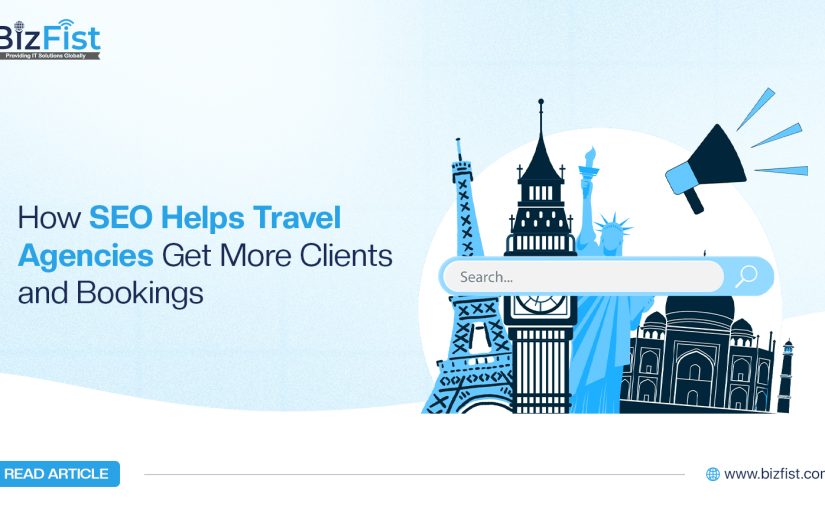
How SEO Helps Travel Agencies Get More Clients and Bookings

How SEO Helps Travel Agencies Get More Clients and Bookings

Imagine someone sitting at home, dreaming of a vacation. They open Google and type: best family getaway from my city. Suddenly, your travel agency shows up in their search results. They click. They browse your tours. And within days, they book through you. Sounds like magic? It isn’t. It’s SEO — done right.

In today’s digital world, SEO (Search Engine Optimization) is one of the most powerful tools a travel agency can use. It doesn’t just bring visitors to your website; it helps the right people find you, those ready to travel, book, and pay.

In this blog, I’ll walk you through how SEO works for travel agents, the exact steps to use, common challenges, and how you can start applying it today. Think of it as your roadmap to turning casual browsers into paying clients.

SEO Helps Travel Agencies Get More Clients and Bookings

1. Why SEO Matters for Travel Agencies

Before diving into techniques, it’s important to know why SEO matters so much in travel.

Travelers Search First

Most people plan trips by first searching online. They look up destinations, hotels, flights, and tours. If your agency isn’t visible when they search, you lose the chance. A study shows that websites ranking first in Google get about 34% of clicks for a query.

Cost-effective Over The Long Run

Compared to constant paid ads, SEO is more sustainable. Once you build ranking authority, you continue getting traffic from organic search. That means you don’t have to pay every time someone
Builds Trust And Credibility

If your agency appears in top search results, people see you as more trustworthy. Good on-page content, proper site structure, and solid backlinks all signal to Google and users that you are a serious, reliable business.

Targets Serious Buyers

Unlike generic social media traffic, SEO brings people who are already searching with intent — people comparing options, looking for holidays, vacation ideas, etc. These are warmer leads more likely to convert into bookings.

2. Key SEO Strategies for Travel Agencies

Now, let’s break down practical strategies your agency can use to rank better and get more bookings.

Keyword Research & Intent Matching

  • Think like a traveler: “beach resorts near me,” “adventure tour in Himachal,” “honeymoon package Delhi to Bali.”
  • Use tools like Google Keyword Planner, Ahrefs, or Ubersuggest to find search volume and competition.
  • Aim for a mix: broad keywords (high volume) + long-tail (more specific, less competition).
  • Match your page content with what people expect. If someone searches for “luxury beach resort,” your page should deliver details about luxury resorts, not budget hotels.

On-Page SEO & Content Optimization

Once you have keywords:

  • Use them in title tags, meta descriptions, headings (H1, H2, H3), and body text (naturally, not forced).
  • Write detailed pages for each tour or destination. Include what to see, where to stay, and travel tips. Long, helpful content tends to perform better. 
  • Optimize images: use descriptive filenames, alt text, and compress size for faster loading.
  • Internal linking: link between relevant pages (e.g., from “Goa beaches” to “Goa adventure tour”) so users and Google find more of your content easily.
  • Use schema markup / structured data where possible (e.g., for reviews, tour packages) — search engines like Google can show rich snippets.

Local SEO: Capture Nearby Clients

If your travel agency also serves local clients (e.g., city or region), local SEO is key.

  • Create or optimize your Google Business Profile (name, address, phone, photos, reviews).
  • Use local keywords: “travel agency in Ludhiana,” “Punjab tours from Phagwara.”
  • Get local citations (listings in local directories, tourism guides).
  • Encourage reviews from clients; positive reviews support both trust and local ranking.

Content Marketing & Blogging

Content is at the heart of travel SEO.

  • Write blog posts answering traveler questions: “best time to visit Rajasthan,” “packing list for Goa,” “hidden gems in Himachal.”
  • Use a consistent content schedule — fresh content signals your site is alive.
  • Evergreen + trending topics: evergreen (always relevant) helps consistently; trending (festival tourism, seasonal events) can draw spikes.
  • Guest posts and collaborations: get your content published on travel blogs, local directories, tourism boards — helps bring backlinks and exposure.

Link Building & Authority Growth

Backlinks (links from other sites to yours) tell Google “you’re trusted”.

  • Reach out to travel bloggers, tourism boards, and media to link to your best content.
  • Create link-worthy assets: infographics, destination guides, and interactive maps that people want to reference.
  • Use outreach, PR, or social share strategies to promote your content and earn links.

Technical SEO & Site Performance

Even with great content, a poor technical setup can hold you back.

  • Make your website mobile-friendly (lots of travel queries come from phones). 
  • Improve page speed: compress images, use caching, and reduce heavy scripts.
  • Use clean URL structures and avoid duplicate content.
  • Use HTTPS (secure site).
  • Fix broken links, ensure proper site navigation.
  • Use XML sitemaps, robots.txt properly to help search engines crawl your site.

3. Common Challenges & How to Overcome Them

SEO in travel is not easy. Here are obstacles many agencies face — and solutions.

ChallengeWhy It HappensWhat You Can Do
High competitionMany travel agencies, big OTAs compete for the same keywordsNiche down (focus on less competitive destinations, narrower themes)
SeasonalityTravel demand fluctuates with the seasonsPlan for slow months; produce evergreen content; promote off-season offers
Dynamic pricing / inventoryTours change, flights vary — affects consistencyUse stable URLs, canonical tags, and avoid creating too many pages for small variants
Algorithm changesGoogle updates can shift ranking factorsStay updated, monitor performance, and adapt your strategy
Link acquisition is hardGetting good-quality backlinks takes time and outreachPartner with local tourism boards, guest blog, create assets people want to link 

4. How to Measure Success & Track SEO

You need to know if your efforts are working. Some key metrics to watch:

  • Organic traffic: Are more people visiting from search engines?
  • Keyword rankings: Are your target keywords moving up?
  • Click-through rate (CTR): How many people click on your result in search?
  • Time on page/bounce rate: Are visitors engaging with your content or leaving quickly?
  • Conversion rate/bookings: The ultimate metric — how many visitors become clients?
  • Backlinks acquired: Are you gaining good-quality links?
  • Page load time / Core Web Vitals: Technical health of your site.
  • Use tools like Google Analytics, Google Search Console, Ahrefs / SEMrush, and monitoring dashboards.

5. A Simple 30-Day SEO Plan to Get Started

Here’s a mini roadmap you can follow to begin your SEO journey:

Week 1

  • Brainstorm 5–10 service/destination pages you want to promote
  • Do keyword research around those
  • Audit your website: check for mobile-friendliness, site speed, broken links

Week 2

  • Optimize titles, meta descriptions, and headings on those pages
  • Add internal links between pages
  • Fix image alt text and compress images

Week 3

  • Start writing blog content (at least 2–3 posts answering traveler questions)
  • Reach out to a few travel blogs or directories for guest posts or link opportunities

Week 4

  • Monitor traffic and rankings with tools
  • Promote your content on social media, local groups
  • Ask happy clients to leave reviews for your local listing

If you keep repeating and expanding this process each month, you’ll see steady growth over time.

Conclusion

Think of SEO as planting seeds for your travel agency’s future. You water them with consistent content, care for them with technical upkeep, and watch them grow into bookings, clients, and lasting relationships.
In the travel industry, being seen matters more than ever because your potential clients are searching right now. When you show up in their results, answer their questions, and build trust, your business becomes more than visible; it becomes preferred.

FAQs

SEO helps your travel agency appear in Google when people search for tours, destinations, and travel packages. When you rank higher, more people visit your website, and many of them turn into real bookings. It attracts ready-to-travel customers without incurring advertising costs.

Travel agencies should use a mix of location-based keywords (like “travel agency in Delhi”), service-specific keywords (“honeymoon packages”), and long-tail keywords (“best family trip ideas from India”). These help attract the right audience who is actually looking to book.

Local SEO helps you show up when people search for nearby travel services, like “travel agency near me” or “tour operator in Ludhiana.” A strong Google Business Profile, reviews, and local keywords can bring more walk-in clients and calls.

Blogs that answer traveler questions perform best — such as “best time to visit Goa,” “top weekend trips,” or “budget-friendly holiday ideas.” Destination guides, travel tips, and detailed tour pages help Google trust your site and increase bookings.

Why Content Quality Should Be Your First Priority for Website Ranking?

Why Content Quality Should Be Your First Priority for Website Ranking?

When you open Google and type something, you want the best and most useful answer, right? Let’s say you are looking for “best digital marketing company near me,” and instead of agencies, you get random, irrelevant websites; you’ll feel disappointed. That’s why Google works hard to display only the most relevant, helpful, and high-quality content at the top.

If you run a website, your goal is to see it appear on Google’s first page, isn’t it? But here’s the secret ingredient: only good content can take you there. In 2025, with so much competition online, content quality has become the most important factor for website ranking. Let’s understand why.

Quality Content

What Does Content Quality Mean?

Content quality isn’t measured by word count alone. It is about giving clear, useful, and trustworthy information to people who are searching for it.

Checklist for a good-quality content:

  • Answer the user’s question directly.
  • Be easy to read and understand.
  • Be original and not copied.
  • Build trust with the reader.
  • Give extra value with facts, examples, or tips.

Think of it like this: If your friend asks you for advice about buying a phone, you don’t just say, “Buy a phone.” You explain features, budget, and your experience. That’s how quality content works – it helps, not just fills space

Why Content Quality Is Google’s Top Priority

Google has millions of websites to choose from. But how does Google choose which websites appear at the top? Simple: the best answers win. Here’s why content quality is most important for ranking:

  1. User Satisfaction – If people find your content helpful, they stay longer on your site. Google notices this and rewards you.
  2. Trust and Authority – High-quality content builds trust. The more trust you gain, the higher your website goes.
  3. Fewer Bounce Rates – Bad content makes people leave quickly. Quality content keeps them engaged.
  4. Long-Term Growth – Ads and tricks can give quick results, but only quality content brings long-lasting ranking.

Understanding the EEAT Principle

Google follows a special rule to check quality, called EEAT. Let’s break it down:

1. E = Experience

  • Content should show real experience.
  • Example: If you write about travelling to Banff, you should share your personal trip story or photos.

2. E = Expertise

  • The writer should know the subject.
  • Example: A doctor writing about health is more trusted than a random blogger.

3. A = Authoritativeness

  • Your website should be a trusted source in your field.
  • Example: A university website has more authority than a new blog.

4. T = Trustworthiness

  • Readers should feel safe on your site.
  • Example: Having correct facts, no fake promises, and secure website links (HTTPS).

How Quality Content Improves Website Ranking

Let’s look at the step-by-step way quality content helps you climb up in Google:

  1. Better Visibility – Search engines scan your content. If it is clear and well-written, it gets shown more often.
  2. More Clicks – If your title and content are attractive, people will click on your website more than others.
  3. More Shares – Good content gets shared on social media, bringing more traffic.
  4. Backlinks – Other websites link to your page if your content is useful. Backlinks are a strong ranking factor.
  5. Returning Visitors – If people like your content once, they will come back again.

What Must You Include in Quality Content?

When you create content for your website, make sure it has a clear purpose. Include these important things:

  1. Clear Headlines – Make it easy for people to understand what the article is about.
  2. Introduction: That Hooks – Start with a problem or question that grabs attention.
  3. Simple Language – Write in a way that even a 6th grader can understand.
  4. Facts and Examples – Use data, studies, or personal stories.
  5. Relevant Keywords – Add words people search for, but naturally (not stuffing).
  6. Helpful Images and Videos – Visuals make learning easier and more fun.
  7. Call-to-Action (CTA) – Tell readers what to do next (buy, sign up, read more).
  8. Updated Information – Outdated info makes readers lose trust.
  9. Structure – Use small paragraphs, bullet points, and subheadings for easy reading.

What You Should Never Do in Content Creation

To succeed in your website ranking, you must avoid mistakes like:

  • Copy-pasting content from other sites.
  • Writing only for search engines, not people.
  • Using too many keywords (keyword stuffing).
  • Giving wrong or fake information.
  • Writing long, boring paragraphs with no value.

Future of SEO: Why Quality Will Always Win

Even as AI and new search engines grow, one thing never changes: people want good answers. Search engines like Google, Bing, and even AI search tools focus on showing the most helpful, clear, and trustworthy content.

This means no matter how many updates or changes happen in SEO, quality content will always be your strongest weapon.

Conclusion

There are no magic tricks or easy shortcuts to rank your site on Google. It is about putting your audience first. If your content is clear, useful, trustworthy, and follows the EEAT principle, your website will naturally rise in ranking.

So, before spending big money on ads or fancy tools, ask yourself one question: Is my content good enough to truly help my audience? Because in 2025 and beyond, the websites that win are the ones that deliver real value.

Want your website to actually show up where your customers are searching? At BizFist IT Solutions, we focus on creating content and strategies that bring you results, not just traffic. Let’s talk about how we can get your business noticed online.

AI-Generated vs. Human Content: Which is Better for Website Ranking?

AI-Generated vs. Human Content: Which is Better for Website Ranking?

In today’s digital world, content optimization is the backbone of every website. Whether you post a blog, run an e-commerce store, or run a service-based business, your content quality determines how search engines rank your business and how visitors engage with your brand. But with artificial intelligence (AI) now capable of generating articles, product descriptions, and even social media posts in seconds, many business owners are asking: Should I use AI-generated content, or is human-written content still the best choice for SEO ranking?

This debate is growing among SEO professionals and digital marketing services providers. AI promises speed and efficiency, while humans bring creativity, authenticity, and emotional connection. Let’s break down the pros and cons of each to understand which works best for improving your Google ranking factors.

human vs ai

A Brief Overview of AI-Generated Content

AI-generated content is written by computer programs powered by machine learning models. These tools analyze massive amounts of data, identify patterns in language, and then generate text that looks like it was written by a person.

Some common examples include:

  • Blog posts generated in minutes.
  • Automated product descriptions for e-commerce stores.
  • Social media captions created with a single click.
  • SEO-friendly articles with pre-inserted keywords.

The main advantage? Speed. A task that takes a human two days can be completed by AI in twenty minutes—making it appealing for businesses needing high-volume content for their SEO services.

A Brief Overview of Human-Written Content:

Human-written content, as the name suggests, is created by real people. Writers use their own knowledge, research, and creativity to develop articles, stories, or sales copy. Unlike AI, humans can connect emotionally with readers, adapt tone to different audiences, and share personal experiences.

Examples include:

  • In-depth blog posts with expert insights.
  • Opinion articles based on real-life experiences.
  • Creative storytelling in brand campaigns.
  • Unique guides that answer user-specific questions.

Human-written content may take longer and cost more, but it brings originality and trustworthiness to the table.

How Content Quality Matters for Website Ranking?

Before comparing AI vs. human content, it’s important to understand what search engines like Google actually look for when ranking websites. Google’s ranking factors heavily focus on:

  • Relevance: Does the content answer the user’s search query?
  • Quality: Is the information accurate, well-structured, and valuable?
  • Originality: Does the content offer something new, or is it just a copy of what’s already online?
  • User Experience: Does the content provide an enjoyable, clear, and engaging reading experience?
  • E-E-A-T (Experience, Expertise, Authoritativeness, Trustworthiness): Does the writer demonstrate real-world experience and credibility?

While human-written content takes more time and money, it builds trust and PROVIDES ORIGINALITY that AI often struggles to replicate—an important factor in Google’s ranking factors.

Strengths & Weaknesses of AI-Generated Content for Website Ranking

Strengths of AI-Generated Content for Website Ranking

  1. Speed and Efficiency
  2. AI is capable of generating thousands of words much faster than a human can. This is ideal for businesses that need high-volume content, such as e-commerce stores with hundreds of product listings.
  3. Cost-Effective
  4. Hiring professional writers can be expensive. AI tools often come at a lower monthly subscription, making them budget-friendly for startups or small businesses.
  5. SEO Optimization
  6. Many AI tools are trained to include keywords naturally, follow SEO guidelines, and even suggest meta descriptions, helping websites rank faster.
  7. 24/7 Availability
  8. AI doesn’t get tired. It can generate content anytime, which is useful for global digital marketing services.

Weaknesses of AI-Generated Content for Website Ranking

  1. Lack of Depth and Originality
  2. AI doesn’t have real-life experience. Its content is based on patterns from existing data, which often leads to generic and repetitive writing.
  3. Risk of Inaccuracy
  4. AI tools sometimes produce incorrect information. Without fact-checking, this can damage credibility and SEO rankings.
  5. No Emotional Connection
  6. AI struggles to capture human emotions, storytelling, or cultural nuances, which are essential for engaging readers.
  7. Google’s View on AI Content
  8. While Google has stated it values quality over authorship, poorly generated AI content that looks spammy can harm search engine optimization practices. If AI content lacks originality or expertise, it may get flagged as low-value.

Strengths & Weaknesses of Human-Written Content for Website Ranking

Strengths of Human-Written Content for Website Ranking

  1. Creativity and Storytelling
  2. Humans can weave stories, share personal experiences, and create content that resonates emotionally with readers.
  3. Trust and Authenticity
  4. When an expert writes content, readers are more likely to trust the information. This aligns perfectly with Google’s E-E-A-T guidelines.
  5. Adaptability
  6. Humans can adjust tone, style, and perspective depending on the audience. AI often struggles with such flexibility.
  7. Strategic Thinking
  8. A human writer understands the brand voice, marketing goals, and customer pain points—things AI can’t grasp without heavy prompting.

Weaknesses of Human-Written Content for Website Ranking

  1. Time-Consuming
  2. Crafting high-quality articles takes hours or even days. Businesses looking for quick results may find this slow.
  3. Higher Costs
  4. Professional writers charge more than an AI tool subscription. For startups with limited budgets, this can be challenging.
  5. Scalability Issues
  6. Producing large volumes of human-written content consistently can be difficult.

Which One Does Google Prefer?

Here’s the most important part: Google doesn’t care if content is written by AI or humans—as long as it is useful, original, and valuable to the reader. In other words:

  • If AI content is spammy, low-quality, or repetitive, Google will push it down.
  • If human content is poorly written or keyword-stuffed, it will also perform badly.

Google’s algorithms are becoming smarter at detecting intent and value. That means the winner isn’t AI or humans—it’s quality content.

The Best Approach for Website Ranking: A Blend of Both

The most effective strategy for digital marketing services and smart business owners today is combining AI with human expertise. Here’s how:

  1. Use AI for Research and Drafting
  2. AI can help generate outlines, keyword suggestions, and even first drafts, saving time for writers.
  3. Let Humans Refine and Add Value
  4. Writers can fact-check, add personal insights, restructure content, and ensure it matches the brand’s voice.
  5. Focus on Originality
  6. Add case studies, real-life examples, or expert opinions that AI cannot create.
  7. Prioritize Editing and Proofreading
  8. Even AI-assisted drafts must be reviewed for grammar, accuracy, and readability. This hybrid approach ensures content is not only fast to produce but also engaging and trustworthy.

Final Words:

So, which is better for website ranking—AI or human content? The answer is simple: quality matters most.

  • Need speed, scalability, and basic SEO? AI can be a great tool.
  • Want depth, originality, and emotional connection? Human-written content wins every time.

In 2025 and beyond, businesses that partner with experienced digital marketing companies like Bizfist IT Solutions in Surrey, BC, and entrust their content management to SEO and creative writing experts will achieve the best search engine optimization results. 

The goal is simple: publish helpful, original, and trustworthy content that your audience loves and that aligns with Google’s ranking factors.

Top 7 Social Media Strategies to Boost Your Brand in 2025

Top 7 Social Media Strategies to Boost Your Brand in 2025

Social media changes fast. A strategy that brought results last year might not give the same outcome this year. In 2025, small business owners in Surrey, BC need to be smart, creative, and ready to adapt if they want their brand to grow.

Whether you’re running a bakery, a clothing store, a fitness studio, or a service business, the right social media strategy can help you attract new customers, keep loyal ones, and build trust.

Here are 7 simple but powerful strategies that can give your brand a boost this year.

Social Media Optimization

7 Winning Social Media Tactics to Strengthen Your Brand in 2025

1. Short-Form Videos Are King

People love quick, fun, and interesting videos. Platforms like TikTok, Instagram Reels, and YouTube Shorts are where customers spend a lot of their time. Why it works:
  • Easy to watch
  • Easy to share
  • Grabs attention fast
What you can do:
  • Show your product in action (e.g., a baker showing the icing process)
  • Share bite-sized tips or clever tricks from your field.
  • Create behind-the-scenes clips that reveal how your business operates.
  • Jump on trending sounds or challenges, but make it fit your brand.
PlatformBest Video LengthStyle That Works Best
TikTok10–30 secondsFun, authentic, trending
Instagram Reels15–60 secondsPolished, colourful, catchy captions
YouTube Shorts15–60 secondsInformative, storytelling


Example:

If you own a coffee shop, make a 20-second video of a latte art competition between your baristas and post it with trending audio.

2. Use AI to Save Time and Personalize Content

AI tools are no longer just for tech experts — they’re now easy to use and can help even small businesses create better content faster. Along with AI, investing in professional digital marketing services can help small businesses create better content faster and stay consistent online

How AI can help you:

  • Write captions for social media posts
  • Suggest content ideas based on trends
  • Design images using AI-powered design tools
  • Schedule posts automatically
  • Analyze engagement to see what works best

Examples of AI Tools for Small Businesses

TaskAI Tool ExampleBenefit
Caption writingChatGPTSaves time
Graphic designCanva AIProfessional look without designer costs
SchedulingBufferPost at the best times automatically
Trend researchTrendTok or BuzzSumoStay ahead of competitors


Example:

Your boutique can use AI to quickly design Instagram post layouts for their new arrivals and schedule them for peak engagement times.

3. Build a Real Online Community

Having followers is good, but having engaged followers is even better. A strong online community will support your brand and recommend you to others.

How to build it:

  • Reply to every comment and message.
  • Request your customers to share photos of themselves using and loving your products.
  • Host polls and quizzes in your Instagram Stories.
  • Run small giveaways for people who share your posts.

Example:
A gym could run a “Member of the Month” feature where followers vote for their favourite inspiring story, and the winner gets a free training session.

4. Work With the Right Influencers

Influencer marketing isn’t just for big brands. In fact, micro-influencers (1,000–50,000 followers) can be even more effective for small businesses because they feel more real and relatable.

Tips for working with influencers:

  • Choose someone whose audience matches your target customers.
  • Look for people in Surrey or nearby areas to reach local buyers.
  • Ask them to create authentic content, not just product ads.

Example:
A bakery could partner with a local food blogger who does “day in the life” videos and feature their pastries in a natural way.

5. Sell Directly Through Social Media

In 2025, you don’t need a separate website to sell — many customers buy directly from social media marketing platforms.

Ways to use social commerce:

  • Tag products in Instagram posts and stories.
  • Use Facebook Shop to list products.
  • Try live selling events where you show and sell in real time.

Offer exclusive social media discounts.

Platform Social Selling Feature Example
Instagram Shoppable posts/stories Tagging your jewelry in a post so people can buy without leaving the app
Facebook Facebook Shop Listing your handmade candles
TikTok TikTok Shop & live selling Selling skincare during a live Q&A

6. Be Honest and Authentic

People can spot fake marketing from a mile away. Being real and transparent makes customers trust you more.

Ways to show authenticity:

  • Show what happens behind the scenes, such as preparing orders or arranging your shop.
  • Show the faces behind your business.
  • Admit small mistakes and show how you fixed them.
  • Share your brand values — like sustainability or local sourcing.

Example:
If you’re a florist, show the process of choosing fresh flowers from local markets, even if it means showing the early morning hustle.

7. Be Active on the Right Platforms

You don’t need to be everywhere — just where your customers are.

Steps to choose your platforms:

  1. Find out where your target audience spends time (Instagram for younger people, Facebook for older, LinkedIn for B2B, etc.).
  2. Make content that fits each platform’s style.
  3. Test new platforms early to reach more people before competitors.

Example:
If you run an accounting service, LinkedIn and Facebook may be better than TikTok, but trying short finance tips on YouTube Shorts could bring in younger entrepreneurs.

Quick Checklist for 2025 Social Media Success

  • Post at least 3–4 times a week
  • Use short-form videos for most updates
  • Reply to every comment and message
  • Try at least 1 AI tool for content creation
  • Partner with a local micro-influencer
  • Sell at least 1 product/service directly through social media
  • Be consistent for at least 3 months before judging results

Final Words:

Social media in 2025 is not about who spends the most money — it’s about who connects best with their audience. If you are a small business owner in Surrey, BC, these strategies can help you:

  • Get noticed online
  • Build trust with your customers
  • Turn followers into buyers

At Bizfist IT Solutions, a trusted digital marketing agency in Surrey, BC, we help entrepreneurs and small business owners like you in Surrey, BC,  create winning social media optimization strategies, run ads that work, and design content that customers love. Let’s connect and make your brand shine in 2025, 2026 and beyond.

How to Optimize Your Blog for AI Search Engines in 2025?

How to Optimize Your Blog for AI Search Engines in 2025?

The way people search online is going through a major shift, and if your blog isn’t prepared, it will get left behind. In 2025, AI-powered search tools like Google’s AI Overviews, Bing’s AI Copilot, and platforms like ChatGPT are not just assisting users—they’re deciding which content gets seen and which doesn’t.

Rather than listing several search results, AI-driven platforms deliver summarized responses right away. They scan the web, understand the content, and deliver direct answers—often without the user clicking on any website. This means your content must now be AI-readable, structured, and instantly useful, or it risks being completely bypassed.

If your blog isn’t optimized for AI Mode:

  • Your organic traffic could drop significantly.
  • Your content may never appear in AI-generated answers.
  • Competitors with better AI-aligned strategies will outrank you even if their content isn’t better, just better formatted.

Whether you’re a solo blogger, digital marketer, or business owner, adapting to AI search is no longer optional. It has become a necessity to stay relevant, visible, and competitive in the digital world of tomorrow.

AI Search Engines in 2025

What is “AI Mode” (AI Search Engines)?

In 2025, search engines like Google won’t just show links anymore. They have grown smarter with AI Mode or AI Overviews. Instead of making you click, they give answers right on the page.

  • AI Overview: A short summary made by AI at the top of search results, with links from top sources. 
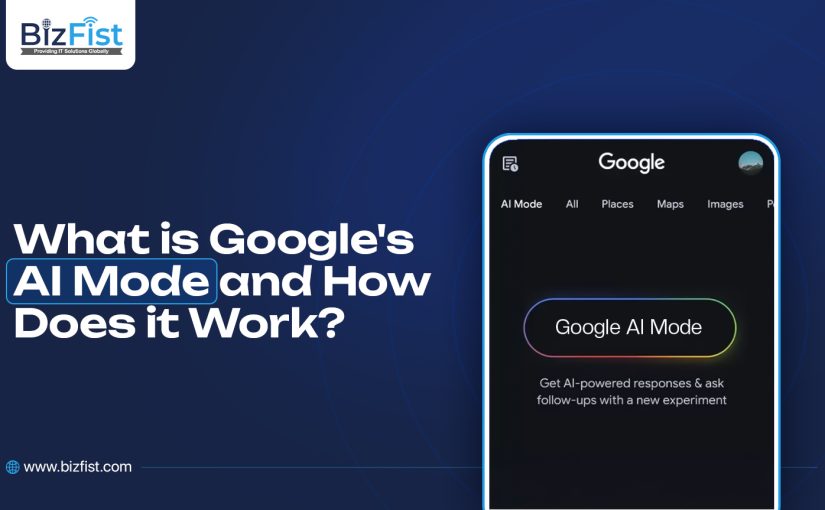
  • AI Mode: A chat‑like interface that explains concepts, lets you ask follow‑ups, and sometimes shows images or tables—powered by advanced AI like Google’s Gemini 2.5.  

So, now searching is more like talking to a smart friend than just clicking links!

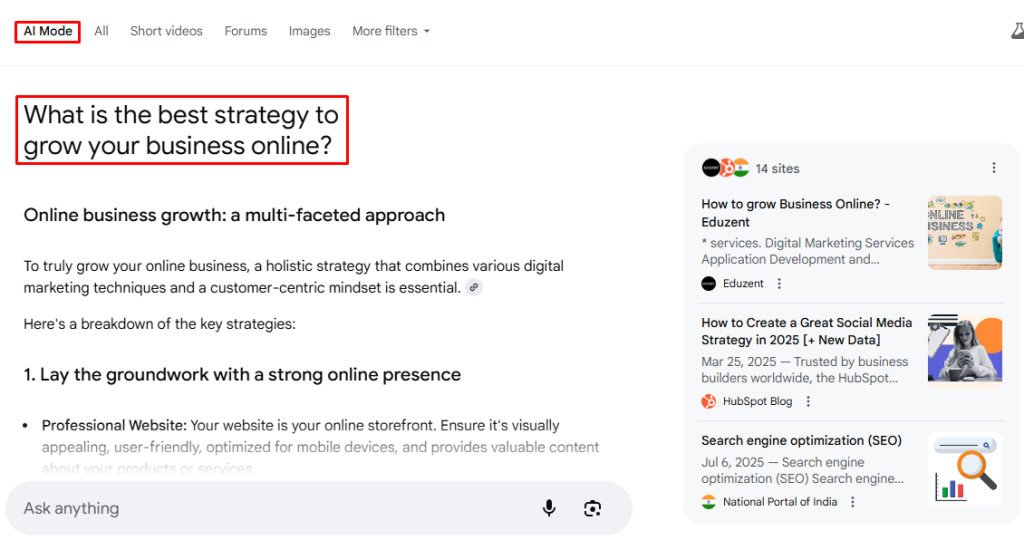
Example Search Query in AI Mode

Let’s look at a real example. Imagine you type:

“What is the best strategy to grow your business online?”

What is the best strategy to grow your business online

You can see that we got the answer directly through AI Mode; there was no need to click on multiple links. Google scanned the top content sources and gave us a summarized response. Even when you click on “Show all,” you’ll only see a limited number of links. This clearly shows how important it is to rank your content in AI-powered search engines.

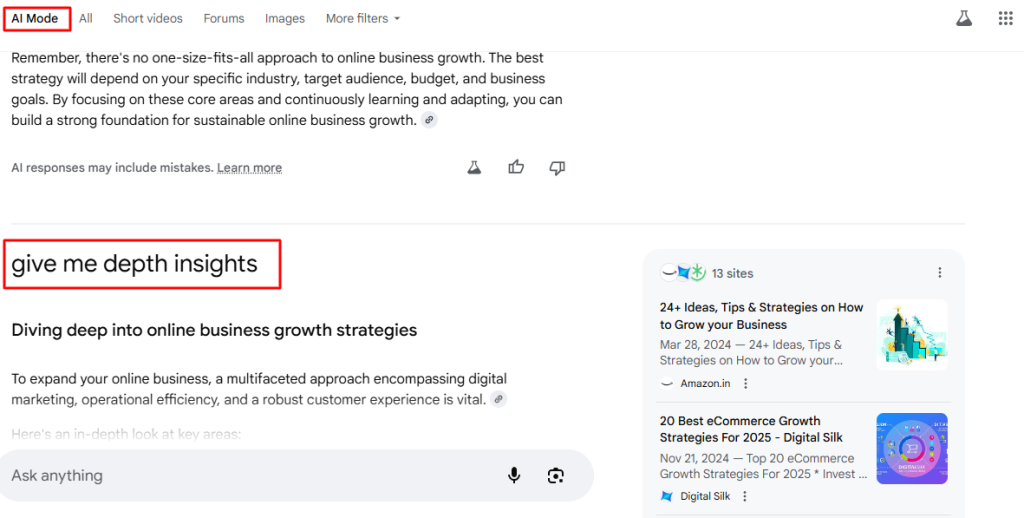
give me depth insights

If you want to ask more questions related to the original query, you can easily do that. This is possible because AI Mode continues the conversation based on your previous search. It understands the context and gives you follow-up answers without starting from scratch.

Impact of AI Mode on Google Rankings

If you have a website, relying only on traditional SEO methods is no longer enough. With the introduction of AI Mode in search engines, several changes can directly affect your website’s visibility and rankings. Here are some key ways AI Mode can influence how your content performs in search results:

  • Traffic per site: Google still drives the most visits; AI search traffic is under 1 % on most sites, so don’t ignore organic search.
  • Brand exposure: Even if readers don’t click, appearing in AI summaries boosts your visibility and authority in platforms like Semrush.
  • Changing success metrics: It’s no longer just clicks or page views. It’s how often AI picks your content in its answers.
search engine

SEO Strategies: Past vs 2025 AI Optimization

SEO Practice Past (before 2025) 2025 (AI‑mode SEO)
Keywords focus Stuff lots of exact terms Use natural, conversational phrases
Content length Long articles with many keywords Short, clear, well‑structured answers
Formatting Paragraphs, few headings Lots of headings, bullets, tables
Featured snippets Aim for snippet placement Optimize for AI summaries
Backlinks Many links for authority Quality sources, credible citations
Update frequency Infrequent updates Regular revisions to stay fresh
Schema markup Minimal use Essential for AI understanding
Multimedia Text mostly Text + images + tables + video
Tracking Click-Through Rate (Focusing on getting clicks from SERPs.) Satisfaction Rate  (Ensuring AI tools can pull direct answers from your text.)

Key Takeaways:

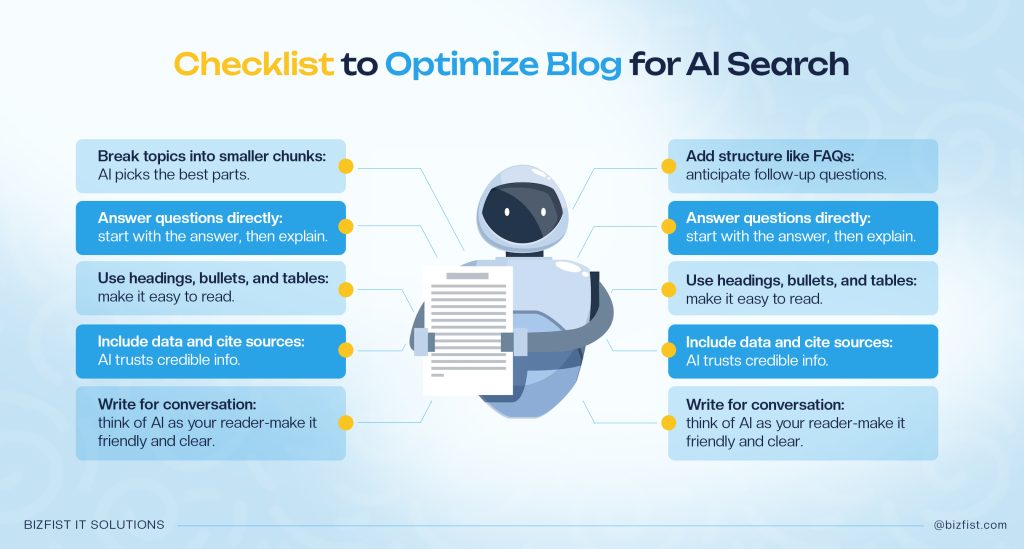
AI Mode is smart—it scans websites and delivers the most accurate answers using credible sources. It also responds directly with follow-up answers. So, if you want your content to rank in AI Mode, make sure your blog is easy to read, well-structured, fact-based, and written in a clear, conversational tone.

Here are a few things to keep in mind to help your content rank in AI Mode:

  • Write direct, friendly answers.
  • Use clear headings, bullet points, and FAQs.
  • Strengthen your blog by including factual details and referencing reliable sources.
  • Keep your blog updated, use schema markup, and include relevant images.
  • Track whether AI tools are picking up your content or skipping it.

If you’re an entrepreneur wearing multiple hats, we’re here to take the digital marketing load off your shoulders. Our dedicated team of SEO professionals, content writers, social media executives, graphic designers, and web developers will not only build your digital presence but also take full responsibility for growing it.

7 Biggest Marketing Mistakes Small Business Owners Make

7 Biggest Marketing Mistakes Small Business Owners Make

Running a small business in cities like Surrey or Vancouver, BC, comes with its fair share of challenges. Between overseeing daily operations, managing staff, and ensuring customer satisfaction, marketing often takes a backseat or gets handled without a clear strategy. But the truth is, that effective marketing is the backbone of business growth. Yet many small business owners unknowingly make common marketing mistakes that cost them time, money, and lost customers.

In this blog, we’ll cover 7 of the biggest marketing mistakes small business owners make and how to fix them, so you can attract more customers, increase your visibility, and grow with confidence in 2025 and beyond.

Top 7 Marketing Blunders Small Businesses Should Avoid

small business owner

1. No Clear Marketing Plan

Many small business owners jump straight into running ads, posting on social media, or creating a website without a clear plan. Without defined goals, a target audience, or a content strategy, your marketing feels scattered and ineffective.

Fix it: Create a simple marketing plan. Define:

  • Who your ideal customer is (location, age, income, interests)
  • Your main goals (brand awareness, leads, sales, etc.)
  • What channels you’ll focus on (Google, Instagram, email, etc.)
  • How often you’ll post or run campaigns

It doesn’t have to be complex, even a one-page plan helps.

2. Ignoring Google Business Profile (GBP)

Your customers are searching for services like yours in your service area in Canada. If your Google Business Profile isn’t claimed, verified, or updated, you’re missing a huge opportunity to show up in local search results.

Fix it:

  • Claim and verify your GBP
  • Add photos, business hours, website links, and service areas
  • Collect reviews and respond to them politely

An optimized GBP boosts your chances of showing up in the top 3 results on Google Maps—a prime spot for local business visibility.

3. Posting Without a Purpose on Social Media

Posting every day doesn’t guarantee sales. Many small businesses post random images, stock quotes, or unrelated content without any real strategy.

Fix it: Focus on creating content that resonates with your local community. Include a mix of:

  • Behind-the-scenes photos
  • Customer testimonials
  • Local stories or community involvement
  • Educational content (e.g., tips or FAQs)
  • Soft promotions with a clear call to action (“Book Now,” “DM us for details”)

Remember, quality > quantity.

4. No Lead Capture System

Lots of businesses don’t collect emails or phone numbers from interested customers. If someone visits your site or likes your page, and you don’t follow up, you’re losing potential sales.

Fix it:

  • Add a simple contact form or newsletter signup on your website
  • Offer a small incentive (e.g., 10% off first service)
  • Use tools like Mailchimp or Brevo to set up automated emails

Even if you don’t sell online, email marketing helps keep your business top of mind.

5. Trying to Be Everywhere

You don’t need to maintain a presence on every social media channel. A lot of business owners end up draining their time trying to juggle Facebook, Instagram, TikTok, LinkedIn, and YouTube all at once.

Here’s a smarter approach: choose one or two platforms where your target audience is most active. For many small businesses in Surrey or Vancouver, Facebook and Instagram are usually the best bet.

Focus your energy on those platforms and maintain a consistent presence. It’s far more effective to manage one channel well than to struggle with too many.

6. Neglecting Local SEO

If your website doesn’t include your location or isn’t tailored for local search, it’s likely to miss out on appearing in results when someone looks for “[Your Service] in Surrey” or searches for options “near me.”

Fix it:

  • Add your city and neighbourhoods to your homepage and service pages
  • Create a contact page with your full address and Google Maps embed
  • Use keywords like “electrician in Surrey” or “Vancouver mobile dog groomer”

Local SEO helps customers nearby find you online quickly.

7. Focusing Only on Sales, Not Value

Constantly promoting discounts, offers, and products without building trust or educating your audience can lead to low engagement and a weaker brand image.

Fix it: Use the 80/20 rule: 80% helpful, engaging content and 20% promotional.

Examples:

  • Tips and how-to guides
  • Explaining your process
  • Showcasing real customer results
  • Answering common questions

People buy from brands they trust. Build that trust by showing value first.

Final Thoughts

Marketing doesn’t have to be overwhelming. By avoiding these common mistakes, small business owners in Surrey, Vancouver, and across BC can create a smarter, more focused approach that actually brings results.

Remember:

  • Start small and stay consistent
  • Know your audience
  • Focus on visibility + trust + action

With the right strategy, your marketing will feel less like a struggle and more like a growth engine. Whether you’re a local salon owner, a security services provider, or a restaurant owner in Burnaby, Richmond, or Abbotsford, small steps in the right direction can make a big difference.

Ready to level up your marketing? Start by fixing just one mistake from this list today. If you need professional digital marketing services in Surrey, Vancouver and across BC, then consult Bizfist IT Solutions.

Google Ads vs Meta Ads: Which Is Right for Your Business?

Google Ads vs Meta Ads: Which Is Right for Your Business?

Are you a small business owner wondering where to spend your advertising money—on Google Ads or Meta Ads (Facebook & Instagram)? You’re not alone! Many business owners just like you are confused about which platform gives the best return. And with ads becoming more expensive and competitive in 2025, making the right decision matters more than ever. In this blog, you will get a detailed analysis of the two choices and what is better for your business growth and budget.

What Are Google Ads?

Google Ads vs Meta Ads: Which Is Right for Your Business?

Google Ads are ads that show up on Google when someone searches for something. For example, if someone types “best digital marketing company near me” and you run a digital marketing agency, your ad can show up right there on top. You can also run Google Display Ads (these appear on websites) or YouTube Ads.

What Are Meta Ads?

Meta Ads include Facebook Ads and Instagram Ads. These are social media ads where you show your business to people based on their interests, location, age, or even their behaviour online. Let’s say you sell handmade candles. With Meta Ads, you can show your beautiful candle pictures to people who follow home décor pages, like aesthetic posts, and live in your city. 

Google Ads VS Meta Ads: 6 Key Differences

Here’s a quick side-by-side comparison to help you see which platform fits your business goals better.

Feature Google Ads Meta Ads (Facebook/Instagram)
Targeting People actively searching People scrolling or browsing
Ad Type Text, image, video, shopping, YouTube Image, video, carousel, story, reels
Intent of audience High intent (they want it now) Low to medium intent (they may like it)
Best for Services, urgent needs, local searches Visual products, brand awareness
Budget flexibility Medium to high Low to medium
Learning curve Bit technical Easy to get started

When Should You Choose Google Ads?

Google Ads are best for businesses that offer services people usually search for when they have an urgent need. For example, if you run a plumbing service, a dental clinic, a legal office, or something like pest control or AC repair, then Google Ads are a great fit. Why? Because people usually go straight to Google when they need these services. They’re not just browsing—they’re looking to hire someone right away. 

With Google Ads, your business shows up right when they type in something like “emergency plumber near me” or “best digital marketing agency in Surrey, BC.” That means you get highly targeted leads from people who are ready to take action. You can also target people in specific locations, run call-only ads, or even show your ad on YouTube. 

Yes, the cost per click might be higher, but the chances of getting a customer are also higher because the intent is strong. So, if your goal is to get quick inquiries, phone calls, or bookings from people actively looking to hire your service, Google Ads is the way to go.

When Should You Choose Meta Ads?

Meta Ads, which include Facebook and Instagram, are excellent if your business is visually appealing and can attract people through eye-catching images or videos. Let’s say you run a boutique, beauty salon, gym, photography service, home bakery, or even an online store selling lifestyle products. In all these cases, people may not be searching for you, but if they see your ad while scrolling, they might stop, get interested, and eventually buy. 

Meta Ads allow you to target people based on their age, location, interests, and online behavior. So, if your product looks good in photos or videos, you have a great chance to catch attention. For example, a beautifully designed cake or a stylish outfit will work well in a Facebook or Instagram ad. These platforms are also more budget-friendly, so even with just $10–$15 CAD a day, you can start getting visibility.

Meta Ads are perfect for building brand awareness, creating a fan base, and slowly turning followers into customers. It’s an ideal option when you’re promoting a lifestyle experience rather than simply offering a product.

Which Is Cheaper in 2025: Google Ads or Meta Ads?

Meta Ads are usually cheaper to get started. You can reach a lot of people by spending a small amount of money. However, it may take more time to convert them into paying customers. On the other hand, Google Ads may cost more per click, but if the customer is ready to buy, that click is more valuable. So:

  • If you want quick leads, go with Google Ads.
  • If you want brand awareness and slow but steady growth, go with Meta Ads.

What If You Have a Very Small Budget?

If your monthly ad budget is under $100 CAD, it’s smarter to start with Meta Ads. You’ll get more visibility, likes, shares, and engagement for less money. It’s a great way to build brand awareness and start showing up in front of your local audience. Once your business grows a bit and you can spend around $200–$300 CAD per month, then you can test out Google Ads with proper keyword targeting to drive high-intent leads—people who are actually searching for your service

What About eCommerce or Online Stores?

If you sell physical products online, both platforms work great—but for different reasons.

  • Use Meta Ads to show beautiful images, run carousel ads, and create buzz.
  • Leverage Google Shopping Ads to connect with shoppers who are ready to buy.

 Tip: Many smart small business owners in 2025 combine both—use Meta to attract and Google to convert.

What’s Right for Your Business: Meta Ads or Google Ads?

if you are still confused about what to choose, here’s a simple way to make a decision:

If You Want…

Go With…

Instant calls/leads

Google Ads

Build brand & awareness

Meta Ads

Sell services (home, local)

Google Ads

Sell products (clothes, gifts)

Meta Ads

Show product photos/videos

Meta Ads

Target people by interest

Meta Ads

Target people by search intent

Google Ads

Best Strategy in 2025? Use Both Smartly

Many growing businesses in 2025 are using a mix of both:

  • Meta Ads for visibility and engagement
  • Google Ads for sales and leads

Start small. Test. Learn. Grow. You don’t have to spend lakhs. Start with $10–$15 CAD a day on PPC services like Google Ads or Meta Ads and track what works. Use free tools like Google Analytics, Meta Ad Manager, or even WhatsApp to follow up with interested leads.

Final Thoughts

No two businesses are the same. What works for a bakery might not work for a plumber. The key is to know your customer, understand their buying behavior, and then use the right ad platform.

Whether you pick Google Ads or Meta Ads—remember: ads don’t work unless you do. Make good creatives, write simple ad copy, offer real value, and track your results.

With the right platform and strategy, even a small business can look big online. And that’s what we all want, right? If you need help in managing ads and driving business growth, Bizfist IT Solutions is here to help you. 

What is Google’s AI Mode and How Does it Work?

What is Google's AI Mode and How Does it Work?

Do you get tired of clicking so many links just to find one simple answer? Today, there’s too much information online, and searching can feel confusing and slow.

To fix this, Google is testing a new feature in the USA called AI Mode. This innovative tool uses Artificial Intelligence (AI) to help you find answers faster. Instead of showing you many links, it gives you clear, complete, and easy-to-understand answers right away.

This new AI Mode could make searching online much simpler and quicker. It might even shift how we approach Search Engine Optimization (SEO) and give rise to smarter content strategies like Generative Engine Optimization (GEO).

How Can You Benefit From AI Mode?

What is Google's AI Mode and How Does it Work?

Google’s AI Mode isn’t just a new look for Search — it’s a whole new way of getting the information you need. Here’s how this smart assistant-like feature can make your online experience smoother, faster, and more helpful.

1. Getting Answers, Not Just Links

Usually, when you search, you get a list of websites that might have the answer. With AI Mode, Google tries to actually give you the answer directly. It reads through a lot of different websites and then puts together a summary for you.

For example, if you ask, “What are the main differences between a Golden Retriever and a Labrador Retriever?”

  • Old Google: Would give you links to breed information websites, articles comparing the two, etc. You’d have to click on several and read through them to find the key differences in temperament, size, grooming needs, etc.
  • AI Mode: Might give you a summary right there, saying something like: “Golden Retrievers tend to have longer fur requiring more grooming, are often described as gentle and eager to please, and might be slightly more prone to certain health issues. Labrador Retrievers have shorter fur, are known for being energetic and playful, and are often very food-motivated.” It would likely also show you a link to the websites where this information was found.

This can save you a lot of time and effort, especially when you’re researching something new or trying to understand a complex topic.

2. Having a Conversation with Search

Traditional search is usually a one-way method of communication. You ask a question, you get results. If you have a follow-up question, you have to do a new search. AI Mode is trying to make it more like a conversation. After it gives you an initial answer, you can ask follow-up questions, and it will try to understand and respond based on the previous answer.

For example, after asking about the Golden Retriever vs. Labrador Retriever, you could then ask: “Which breed is better for a family with young children?” and AI Mode would try to give you an answer based on the typical temperaments and energy levels of both breeds.

This conversational aspect can make the search process much more interactive and help you explore a topic in more depth without having to start a new search every time you have another question.

3. Searching with Images

One of the really innovative features of AI Mode is its ability to understand images. This is thanks to its integration with Google Lens. You can take a picture of something with your phone or upload an image, and then ask AI Mode questions about it.

For example: 

  • You could take a picture of a plant and ask: “What kind of plant is this and how do I care for it?” 
  • You could take a picture of a historical building and ask: “When was this built and what is its significance?”
  • You could even take a picture of a complex math problem and ask: “Can you help me solve this?” (While AI Mode isn’t primarily a math solver, its ability to understand visual information opens up possibilities).

This makes AI Mode a powerful tool for visual learners, expanding the ways in which SEO (Search Engine Optimization) and GEO (Generative Engine Optimization) strategies need to adapt to cover visual and multi-modal search behaviors.

4. Gathering Information Like a Detective

When you ask a complex question, AI Mode doesn’t just look at a few top websites. It uses a technique called “query fan-out.” Think of it like a detective investigating a case. Instead of just interviewing one witness, the detective talks to multiple people, looks at different clues, and gathers information from various sources.

Similarly, AI Mode takes your question and breaks it down into smaller, related questions. It then simultaneously searches for information related to each of these sub-questions. This allows it to gather a much wider range of information and provide a more comprehensive and well-rounded answer than a traditional search might.

5. Showing Its Work (Links to the Sources)

Even though you get a direct answer, AI Mode always links to the websites it pulled information from. This builds trust and helps you explore further.

For digital marketers and site owners, this means AI Overviews will still drive traffic — but only if your content is credible, well-structured, and high-quality.

That’s why GEO and SEO strategies now require focusing not just on ranking, but on being referenced by AI as a reliable source.

6. Making Comparisons Easier

If you’re trying to decide between two things, like two different phones or two different vacation destinations, AI Mode can be really helpful. It can generate comparison tables that lay out the key features and differences side-by-side.

For example, if you ask: “Compare the iPhone 16 and the Samsung Galaxy S24,” AI Mode might create a table showing the screen size, camera specs, battery life, price, and other important features of both phones, making it much easier for you to see the pros and cons of each.
7. The Future is Personal (Maybe!)

Google is also thinking about how AI Mode could become even more helpful in the future by personalizing the results. Imagine if AI Mode could take into account your past searches (with your permission, of course) to give you even more relevant answers. For example, if you’ve been researching electric cars, and you ask about the latest car reviews, AI Mode might prioritize reviews of electric vehicles based on your past interest.

Final Thoughts

AI Mode is more than just a fresh update to Google Search — it’s a major shift in the way we access and interact with information. Instead of simply showing a list of links, it focuses on giving you direct answers, helpful summaries, and deeper explanations. Whether you’re trying to understand a complex topic or just looking for a quick fact, AI Mode makes the process faster and smarter.

It also makes searching more natural and engaging with voice and image search, and it builds trust by clearly showing where its information comes from. Though still evolving, AI Mode offers an exciting preview of the future — where search feels less like a task and more like a conversation with a smart, reliable assistant ready to help you learn, explore, and make informed decisions. It’s like having a research partner right at your fingertips.

A Complete Overview of Google Algorithm Updates 2025

A Complete Overview of Google Algorithm Updates 2025

If you are thinking about what it takes to rank a website on top of Google’s search results in 2025, then you’re not alone.

Many websites regularly update their content, improve SEO, and keep up with trends — yet, not all of them reach that top spot or rank on the first page on search engine results. As you probably know, the website that ranks #1 on Google gets the most clicks, traffic, and credibility from users. That’s why improving your Google ranking is crucial for businesses aiming to boost visibility, drive traffic, and earn trust online.

Google has rolled out some major updates to its algorithm — making search results more useful, more accurate, and more trustworthy for users. These changes are already reshaping the way websites create content, structure their pages, and connect with audiences.

In this blog, we’ll break down all the important updates Google made in 2025 — in clear, easy-to-understand terms, without unnecessary jargon. We’ll also include real-world examples to help you see how these changes affect everyday businesses.

google algorithm

Breaking Down Google’s Major 2025 Search Algorithm Changes

On March 13, 2025, Google initiated its first core update of the year, concluding the rollout on March 27, 2025. This update aimed to refine how Google evaluates and ranks content across the web.

AI Mode: A New Way to Search

What is AI Mode?

In March 2025, Google introduced a new experimental feature called AI Mode for search. This feature is powered by Google’s Gemini 2.0 AI model and is currently available to users subscribed to the Google One AI Premium Plan in the U.S.

What it does:

  • Smart Answers: You can now ask complex questions, and Google’s AI will give you a complete answer, not just links.
  • Multi-Input Support: You can combine voice, images, and text in one search.
  • Deeper Results: The AI uses reasoning and context to deliver more personalized answers.

Case Study:

An online education platform used AI Mode to improve the way students search for study materials. By typing a specific topic or uploading an image from a textbook, students could now get tailored explanations. They also got direct links to relevant resources, which helped reduce the time they spent searching.

Focus on User Experience (UX) (Speed and Mobile Matter More)

What changed?

Google made it clear in 2025 that a good user experience is non-negotiable. If your website is slow, hard to navigate, or not mobile-friendly, it won’t rank well.

Key updates:

  • Core Web Vitals: Metrics like page loading speed, mobile responsiveness, and visual stability now have a greater effect on rankings.
  • Better Layouts: Sites with cleaner designs and fewer pop-ups are performing better.

Case Study:

An online clothing store updated its website layout, improved mobile responsiveness, and reduced loading time. After the changes, the site’s rankings jumped, and sales from mobile users increased by over 30%.

AI Overviews (Search Results Are Getting Smarter)

What are AI Overviews?

Google has expanded its use of AI-generated summaries in search results. Now, instead of just showing you links, it often gives you a brief answer right on the search page.

Why it matters:

  • Quick Info: Users get direct answers faster, without needing to visit a website.
  • Source Credibility: Google includes links to original sources, so users can explore further if they want.

To maintain and improve website visibility, businesses need to create content that goes beyond what AI can summarize—like personal experiences, tips from experts, or things that actually make users stay and interact.

Case Study:

A food blog that had ranked well for basic “how-to” cooking guides noticed a drop in traffic. That’s because users now saw summaries of those guides directly in search results. In response, the blog started creating unique recipe walkthroughs with personal stories, expert tips, and videos—content that AI summaries couldn’t replace.

Less Focus on Backlinks, More on Relevance

What changed?

For years, having a lot of backlinks (links from other sites pointing to yours) was a key way to rank higher on Google. But in 2025, Google started placing less importance on backlinks and more on whether your content actually answers the user’s question.

New Rules:

  • Quality Over Quantity: One strong, relevant backlink is better than dozens of random ones.
  • Content First: Pages that answer user intent directly—even if they don’t have many backlinks—can still rank high.

Case Study:

A tech blog that had invested heavily in link-building saw its rankings decline, while a newer site that focused on well-researched product reviews started climbing the ranks. Why? It’s because users were engaging more with the newer site’s content, which sent strong signals to Google that the content was helpful.

5 Key Takeaways for Website Owners and Marketers

To make the most of these updates, many businesses are turning to local experts. A digital marketing company in Surrey, BC can help you implement AI tools, optimize website performance, and create user-first content strategies that align with Google’s evolving algorithm. Here are some key takeaways for website owners and marketers.

Content is King (Still)

If your content is helpful, original, and written with the user’s benefits in mind and not just for SEO, then your digital marketing strategies are on the right track.

User Behavior Tells Google Everything

Are users spending time on your site? Are they clicking, scrolling, reading, and coming back? That’s what matters now.

AI Integration Is Growing

Start thinking about how AI will affect the way users interact with your content. Optimize for more than just keywords.

Speed and Simplicity Win

Make your site fast, easy to use, and mobile-friendly.

Authority Comes From Trust

Build trust with your audience—whether that’s through expert authorship, clear sourcing, or transparent business practices.

Final Thoughts

Google’s algorithm updates in 2025 made one thing clear: it’s no longer just about keywords, backlinks, or stuffing pages with content. The search engine is getting smarter, and it’s looking for content that genuinely helps people.

Websites that focus on quality, relevance, and real user value are seeing better rankings and more organic traffic. Those who ignore these trends risk losing visibility altogether.

Whether you post a blog or run an e-commerce or a company website, understanding these changes will help you stay ahead. After all, when your content helps people, Google takes notice—and rewards you for it.

In the race to the top of Google’s results, let BizFist IT Solutions be the engine that drives your digital success.

How to Grow Your Business Organically on Social Media in 2025?

How to Grow Your Business Organically on Social Media in 2025?

Do you want to build your business on social media without spending money on ads? If yes, you’re in the right place. Organic growth helps you gain real followers, boost engagement, and attract customers without paid promotions. It takes time and effort, but the results last longer and build a strong brand.

In 2025, social media is more competitive than ever. But don’t worry—if you follow the right strategies, you can still grow your business organically and attract the right audience. Let’s talk about how you can do it.

10 Proven Strategies to Grow Organically on Social Media

Business Organically on Social Media

1. Post High-Quality, Valuable Content

Social media users see thousands of posts every day. If you want your target audience to stop scrolling, grab their attention by creating valuable content.

Ask yourself:

  • Does my post solve my target audience’s problem?
  • Does it educate or entertain them?
  • Is it something people would want to share?

For example, if you run a car rental company, share tips on choosing the right vehicle for a road trip, saving money on long-term rentals, or understanding insurance options. Your goal is to position yourself as a reliable service provider so people trust you.

2. Leverage Video Content

Video is the most engaging content format in 2025. Platforms like Instagram Reels, YouTube Shorts, and TikTok push short-form videos to a wider audience. Here’s how you can use video:

  • Share success stories from clients who built strong personal brands.
  • Give quick tips in 30-60 seconds.
  • Show behind-the-scenes content about your business.
  • Hold live Q&A sessions to interact with your audience.

If you’re not comfortable on camera, use AI tools to create animated videos or voiceovers for social media.

3. Engage With Your Audience Daily

Social media is not just about posting—it’s about conversations. Respond to comments, reply to DMs, and engage with other people’s posts.

Here’s what you should do:

  • Spend 15-30 minutes daily interacting with your followers.
  • Comment on posts from people in your industry.
  • Join discussions in relevant groups and forums.

When you engage actively, people notice you. This builds relationships and trust, which leads to organic growth.

4. Use AI-Powered Insights for Strategy

AI tools help you analyze what’s working and what’s not. Instead of guessing, use data to improve your content strategy.

What can AI tools do for you?

  • Recommend optimal posting times to maximize reach.
  • Identify the content formats that generate the highest engagement.
  • Generate content ideas based on trending topics.

Social media marketers who update their strategies frequently see faster growth. If you want to stay ahead, embrace AI.

5. Build Your Personal Brand

People connect with people, not just businesses. If you want to grow organically, you need to show your personality. Share your journey, challenges, and wins.

Here’s how:

  • Tell your story: Why did you start your business?
  • Share client success stories to build credibility.
  • Give insights from your personal experiences.

When people relate to you, they are more likely to trust and buy from you.

6. Collaborate With Other Creators

Growth happens faster when you collaborate. Partner with influencers, industry experts, and other entrepreneurs.

Collaboration ideas:

  • Do Instagram or LinkedIn Lives with experts in your field.
  • Feature guest posts from industry leaders.
  • Tag and engage with bigger accounts to get noticed.

When you tap into someone else’s audience, you gain new followers who are already interested in your niche.

7. Encourage User-Generated Content (UGC)

People trust content from real users more than brand promotions. If your clients share their experiences, it builds credibility.

Ways to encourage UGC:

  • Ask clients to post testimonials and tag your page.
  • Run a contest where users share their results using your service.
  • Feature customer posts on your social media.

This creates a community and boosts organic reach.

8. Be Consistent and Patient

Organic growth takes time. Posting once in a while won’t work. Be consistent, whether you post daily or a few times a week.

Follow this simple plan:

  • Set a content schedule and stick to it.
  • Keep testing what works best.
  • Don’t get discouraged—growth compounds over time.

9. Optimize Your Social Media Profiles

Your profile is the first thing people see. Make sure it looks professional and clearly explains what you do.

Here’s how:

  • Use a high-quality profile picture and cover image.
  • Write a clear bio with keywords related to your business.
  • Add a link to your website or services page.

A well-optimized profile helps you attract the right audience and increases credibility.

10. Stay Updated with Social Media Trends

Social media changes fast. If you want to stay relevant, you need to keep up with the latest trends and algorithm updates.

Here’s what you can do:

  • Follow industry experts and social media news sources.
  • Experiment with new features like AI-driven content tools.
  • Refine your strategy by learning from successful trends in your niche.

Being ahead of trends helps you stay visible and competitive.

Final Thoughts

Growing your business organically on social media in 2025 is possible if you focus on quality content, engagement, and strategy. Personal branding plays a big role—people want to connect with experts who provide value.

Start implementing these tips today, and you’ll see steady growth over time. Need help with personal branding? Contact Bizfist IT Solutions to post engaging content, attract more customers, and boost your bookings!

DeepSeek vs. ChatGPT: Which One Is Better?

DeepSeek vs. ChatGPT: Which One Is Better?

We are living in the era of AI, and content is king! With over 5 billion social media users and rising competition, businesses must leverage AI to stay ahead. Research shows that more than 378.8 million people are using artificial intelligence (AI) tools, and this number is expected to reach 729.11 million by 2030! 

One of the most popular free AI tools for social media and content marketing is ChatGPT, which also offers a paid version. This tool has over 300 million weekly users. However, another AI tool has even surpassed ChatGPT in downloads and is now the most downloaded AI tool in the US market. It is also currently growing in the Canadian and Indian markets. It’s DeepSeek.

DeepSeek-vs-ChatGPT

In this blog, we will compare both AI tools—ChatGPT and DeepSeek. Let’s see which one is the best out of the two!

DeepSeek vs Chat GPT With Prompts Testing

Answering Ability

In this test, we will evaluate how strong the answering ability of the tool is. What is the difficulty level of its answers? Does the tool provide justifiable and relevant answers to the questions asked?

Prompt Chat GPT’s Response DeepSeek’s Response
What is the most important thing in digital marketing? In short The most important thing in digital marketing is understanding your target audience—their needs, behaviours, and preferences—so you can deliver the right message through the right channels at the right time. The most important thing in digital marketing is understanding your audience. Knowing their needs, preferences, and behaviours allows you to create targeted, relevant, and effective campaigns that drive engagement and conversions.

Our Analysis:  Their answers are almost the same. But you see, ChatGPT gave the entire answer in a single sentence. That one sentence spans three lines, which makes it less readable. On the other hand, DeepSeek’s response was split into two lines—not too good, but more readable than ChatGPT. When we checked the grammar score on Hemingway, DeepSeek’s score was at a readability level of grade 16, but ChatGPT’s was even higher.

Uniqueness

Today, AI tools like ChatGPT and DeepSeek are widely used for content marketing. Hence, uniqueness is an important parameter for testing these tools. In this test, we will check: Whether the answers generated by these tools are unique or plagiarized.

Our Analysis: We have checked the plagiarism of the response from the above-mentioned query. 
The content generated by Chat GPT and DeepSeek is 100% unique and plagiarism-free. 

Multilingual Capability

This test will determine whether these tools can understand and respond in languages other than English, such as French.

Prompt Chat GPT’s Response DeepSeek’s Response
Parlez-moi en 50 mots de la culture en Colombie-Britannique. La culture de la Colombie-Britannique est diversifiée, influencée par les traditions autochtones, l’héritage européen et les communautés asiatiques. La province célèbre l’art, la musique et les activités de plein air, avec des festivals comme le Vancouver International Film Festival. La nature joue un rôle clé, inspirant un mode de vie durable et le tourisme d’aventure. La culture en Colombie-Britannique, au Canada, est un mélange dynamique d’influences autochtones, asiatiques et européennes. Elle se caractérise par une scène artistique et musicale vibrante, une cuisine diversifiée, et un engagement envers la nature et le plein air. Les traditions autochtones y occupent une place centrale, enrichissant l’identité culturelle de la région.

Our Analysis: Both AI tools have the capability to understand and answer in languages other than English.

Transliteration

Transliteration refers to writing words from one language in another script. This test will check if the tool can interpret Hinglish input and respond correctly in the requested language.

Prompt Chat GPT’s Response DeepSeek’s Response
Mai ek small business entrepreneur hu, based in Surrey, Canada. Kya mujhe starting phase mei he website banva leni chahiye ya wait krun? Answer in English. Yes, you should create a website in the starting phase itself. A website builds credibility, helps customers find you online, and showcases your products or services. Even a simple website with essential details (about, contact, services) can boost your business. Waiting may slow your growth and limit customer reach. Yes, you should consider creating a website in the starting phase of your small business. A website helps establish your online presence, builds credibility, and makes it easier for customers to find and connect with you. Even a simple, professional website can showcase your services, contact details, and location (Surrey, Canada), helping you reach a wider audience and compete effectively. It’s a cost-effective way to market your business and grow your brand from the start.

Our Analysis: ChatGPT and DeepSeek both have the capability to understand transliteration. Plus, both of their answers are justifiable.

Both tools provided similar reasoning, but DeepSeek’s response feels more persuasive, especially with the phrase “definitely consider” in the first line. In contrast, ChatGPT’s response is clear but lacks the same level of persuasion.

Accuracy

We need to check how accurate the answers provided by these tools are. Accuracy is a crucial factor in gaining trust among readers. This test will determine whether the tool’s responses are reliable or not.

Prompt Chat GPT’s Response DeepSeek’s Response
What is the current global population? As of February 26, 2025, the global population is estimated to be approximately 8.2 billion people. As of October 2023, the current global population is estimated to be approximately 8.05 billion people, according to the latest data from the United Nations and other demographic sources like Worldometer.

Our Analysis: The data of DeepSeek is not yet updated. However, Chat GPT has responded with up-to-date info with a source. 

Final Analysis

According to our tests, ChatGPT and DeepSeek are both competitive AI tools for generating information. If you insert a query, you will get a justifiable answer. Both of their responses are unique. 

The plus point of DeepSeek is that it provides detailed answers with better readability scores in comparison to ChatGPT.  However, the advantage of ChatGPT is its faster response time, up-to-date information, and ability to cite sources. 

Overall, it’s a tie between the two AI tools for content generation. Both are competitive and reliable AI tools for content marketing and are continuously being updated.

Top Strategies to Boost Your Digital Brand Presence in 2025

Top Strategies to Boost Your Digital Brand Presence in 2025

Did you know the world’s wealthiest individuals include entrepreneurs and influencers, but not employees? If you aspire to become rich, it’s essential to start your own business, promote it online, and establish a strong personal brand on social media.

Internet marketing covers a wide range, from website development and SEO to social media marketing. Platforms like Instagram, Facebook, LinkedIn, and more play a key role in this space. In this blog, you find strategies that will help you grow your digital presence to the next level.

10 Tactics to Strengthen Your Digital Brand in 2025

1. Invest in AI-Powered Personalization

digital marketing

AI is changing the way we market online. By using AI on your website, you can offer a more personalized experience to your customers. Although it might cost a bit, it’s a smart way to keep them engaged and loyal. Here’s how you can leverage AI to boost your brand:

  • Dynamic Content Recommendations: Use AI tools to recommend products, services, and content based on what your target audience likes, making them feel more connected to your brand.
  • Chatbots with Personality: Gone are the days of generic chatbots. Now, you can create smart chatbots that understand emotions and give answers that feel personal, making users more interested and engaged.
  • Hyper-Targeted Ads: Use AI to find the right audience for your ads and show them exactly what they need. This helps you get the best results and spend your money wisely.

2. Approach Micro-Influencers

In 2025, mega influencers are becoming less effective as audiences seek authenticity. Micro-influencers (with 10k-50k followers) have higher engagement rates and more trust within their communities. Here’s how to use them effectively:

  • Build Long-Term Partnerships: Instead of running single campaigns, collaborate with micro-influencers to build a consistent narrative for your brand.
  • Focus on Niche Audiences: Choose influencers whose followers align with your specific industry or product category.
  • Encourage Authentic Content: Allow influencers to present your brand in their unique voice instead of scripted posts.

3. Adopt a Multi-Platform Strategy

Relying on just one or two platforms is no longer sufficient. Expand your digital presence by diversifying:

  • Emerging Platforms: Keep an eye on upcoming platforms like BlueSky, Kick, and Damus which are gaining traction in 2025.
  • Repurpose Content Smartly: Adapt your content for various platforms to reach a wider audience. For example, a long-form blog can be shared on Medium, turned into LinkedIn posts, or repurposed as an Instagram reel to make the most of your content.
  • Local Social Media Networks: If you’re targeting a specific region, explore local platforms that are popular in that area, such as Facebook, Instagram, TikTok, or LinkedIn in Canada.

4. Interactive Content is King

Static content is losing its charm. Interactive content drives more engagement and keeps users hooked. Here are some ideas:

  • Quizzes and Polls: Platforms like Buzzfeed thrive on quizzes. Create fun, insightful polls and quizzes tailored to your audience.
  • Augmented Reality (AR) Experiences: Allow users to “try” your product virtually, such as using AR to test furniture placement in their homes.
  • Interactive Videos: Instead of traditional videos use clickable, interactive videos that allow users to choose what happens next.

5. Master Voice Search Optimization

With the rise of voice assistants like Alexa, Siri, and Google Assistant, optimizing for voice search is a game-changer in 2025. Here’s how:

  • Use Conversational Keywords: Voice searches are often phrased as questions or conversational statements. Optimize your content with keywords related to your business and WH questions. 
  • Focus on Local SEO: Since many voice searches are focused on location, make sure your business is registered on Google My Business and that your content features location-specific keywords.
  • Answer FAQs Directly: Create content that answers common questions in a concise and natural tone, as this is what voice assistants prioritize.

6. Prioritize Sustainability Messaging

Consumers in 2025 are increasingly conscious of environmental issues. Brands that showcase their commitment to sustainability have a competitive edge. Here’s how to incorporate this into your digital branding:

  • Transparent Storytelling: Share behind-the-scenes content about your sustainable practices, such as eco-friendly packaging or energy-efficient operations.
  • Collaborate with Environmental Causes: Partner with NGOs and actively support initiatives to show genuine commitment to sustainability.

7. Embrace Data Privacy and Security

Data privacy is no longer just a buzzword—it’s essential. With stricter regulations like Canada’s Personal Information Protection and Electronic Documents Act (PIPEDA), brands must be transparent about how they collect, store, and use customer data. Prioritize security to build trust and maintain compliance.

  • Simplify Privacy Policies: Use clear, simple language to explain how you collect and use data.
  • Offer Opt-In Choices: Give users control over what information they share with you.
  • Secure Your Website: A secure website with HTTPS and proper encryption builds trust with users.

8. Use Advanced Analytics for Smarter Decisions

Data-driven decisions are more important than ever. Use advanced analytics tools to gain insights and fine-tune your strategies:

  • Predictive Analytics: Tools like Tableau or Google Analytics 4 can help forecast trends and user behaviour.
  • Track Micro-Metrics: Go beyond likes and impressions. Focus on deeper metrics like engagement rate per follower or time spent on a reel.

9. Focus on Community Building

Building a loyal community around your brand ensures long-term success. Here’s how:

  • Exclusive Communities: Create private groups on platforms like Telegram for your most loyal customers.
  • User-Generated Content Campaigns: Encourage your audience to create content featuring your products, and showcase it on your platforms.
  • Reward Programs: Develop loyalty programs that offer exclusive benefits to repeat customers.

10. Be Consistent, Authentic, and Relatable

Finally, no strategy will work if your brand lacks consistency and authenticity.

  • Consistent Messaging: Ensure your tone, visuals, and messaging align across all platforms.
  • Authentic Storytelling: Share real stories about your journey, your challenges, and your triumphs.
  • Relatable Content: Speak your audience’s language and address their pain points directly.

Final Words:

With so much competition out there, a strong digital presence isn’t optional; it’s a necessity. Whether you’re running a small business or building your brand, focus on consistent efforts and authentic interactions. The digital world is competitive, but with the right strategies, you can stand out and succeed!     

A strong digital presence is your ticket to success in 2025. Need help? BizFist IT Solutions offers everything from website development to social media management. Let’s grow your brand together—contact us today!       

5 Common Mistakes People Make in Personal Branding

5 Common Mistakes People Make in Personal Branding

Let’s be real—personal branding isn’t just a buzzword anymore. It’s your ticket to boosting your earning potential, whether you’re trying to grow your business, land that dream job, or become an influencer. But here’s the catch: many people make avoidable mistakes that hold them back from building a strong personal brand.

If you’re using Instagram, LinkedIn, or YouTube, these platforms offer incredible opportunities for personal branding. But to make the most of them, you need to avoid some common mistakes that can kill your chances of standing out. Keep reading, and we’ll show you exactly what to avoid and how to fix it.

Mistake #1: Not Defining What Makes You Unique

personal branding

Why this hurts your brand: If you don’t clearly define what makes you unique, you’re going to blend in with everyone else because there are a lot of accounts on social media. You can easily go unnoticed in the crowd. Think about it—whether on Instagram, LinkedIn, or YouTube, if your audience doesn’t know what sets you apart, they won’t follow you or engage with your content.

How to fix it: Before you post anything, get clear on your Unique Value Proposition (UVP). Ask yourself: “What unique value do I bring to my target audience that sets me apart from others?” Whether it’s a special perspective, deep expertise, or a personal touch, make sure this comes across in your bio, posts, and videos. People need to know right away why you’re different.

  • For Instagram, your bio should quickly tell people who you are and what they can expect from your feed. 
  • On LinkedIn, highlight your professional skills in a way that shows what makes you stand out. 
  • On YouTube, make sure your intro videos explain exactly what your channel is about and why it’s worth following.

Mistake #2: Inconsistent Branding Across Platforms

Why this hurts your brand: Inconsistent branding is a killer. If your look, tone, or message changes too much across Instagram, LinkedIn, and YouTube, your followers won’t know what to expect, and you’ll lose their trust.

How to fix it: Consistency is key. Your brand identity should be clear on all platforms. This doesn’t mean you have to post the same content everywhere, but the overall message, visuals, and tone should align.

Example: Let’s say you’re a fitness coach. 

  • On LinkedIn, you might share professional articles, fitness industry trends, and client success stories with a polished, business-like tone. 
  • On Instagram, you might show workout videos, behind-the-scenes moments, or personal stories, but your style and message should still reflect your fitness expertise and the motivation you provide. 
  • On YouTube, you could upload longer workout tutorials or educational videos about health, but the branding—like your logo, colours, and tone—should stay consistent with what your audience has come to expect from your Instagram and LinkedIn.

Mistake #3: Not Engaging with Your Audience

To evaluate content quality, Google uses the E-E-A-T (Expertise, Experience, Authoritativeness, and Trustworthiness) framework. If you’ve used AI to create content that includes expert insights and is supported by reliable sources, it will have a better chance of ranking well. For example, if an AI article is about science, it needs to be factually correct and well-sourced to pass Google’s trust test.

Why this hurts your brand: Posting content is important, but it’s not enough. If you don’t interact with your audience, you’re losing the chance to foster connections and earn their trust. People want to feel like they know you, and the best way to do that is through regular interaction.

How to fix it: Don’t just post and ghost. Make it a priority to respond to comments, answer messages, and join conversations.

  • On Instagram, you should reply to DMs and comments directly. 
  • On LinkedIn, you should engage with industry discussions and comment on posts from others in your network. 
  • On YouTube, encourage comments on your videos, and make sure you’re responding to them.

The more you engage, the more your audience will trust you—and trust leads to loyalty and more opportunities.

Mistake #4: Ignoring the Power of Visual Content

Why this hurts your brand: In the age of Instagram and YouTube, visuals are everything. If your content doesn’t have a visual element that grabs attention, it’s going to get lost in the SWIPE NEXT. High-quality photos, graphics, and videos are essential to capturing your audience’s interest and making your brand memorable.

How to fix it: Invest in creating or sourcing high-quality visuals for your brand.

  • On Instagram, your photos and videos should be eye-catching and high-quality. This doesn’t mean you need a professional photographer, but you should aim for well-lit, clear, and engaging content. 
  • On LinkedIn, try sharing infographics or visually appealing charts to make your posts stand out. 
  • For YouTube, focus on creating custom thumbnails that grab attention and make viewers want to click.

Pro tip: People are more likely to engage with posts that have striking visuals. So, whether it’s a catchy graphic on LinkedIn or a vibrant Instagram post, make sure your post boosts!

Mistake #5: Prioritizing Quantity Over Quality

Why this hurts your brand: Posting a lot of content isn’t the answer. In fact, posting just for the sake of posting can harm your brand. If your content isn’t valuable, relevant, or high-quality, it’ll end up overwhelming your audience—and you’ll lose their attention.

How to fix it: Quality always wins over quantity. Concentrate on developing meaningful content that addresses the needs and interests of your audience. Whether it’s a thought-provoking post on LinkedIn, a well-edited video on YouTube, or a beautifully crafted photo on Instagram, make sure each post offers something worth your time.

Remember, it’s better to post less often but with quality content that delivers value. This builds credibility and ensures your audience remains engaged over time.

Final Words:

Building a strong personal brand is a wise decision, but it’s crucial to avoid these common mistakes if you want to unlock your full earning potential. By defining your unique value, maintaining consistency across platforms, engaging with your audience, using impactful visuals, and prioritizing quality, you’ll set yourself up for success.

Take these tips to heart, apply them consistently, and watch your personal brand grow—along with your opportunities for collaboration, business growth, and career advancement. If you need assistance with personal branding, we at Bizfist IT Solutions are here to help you manage and grow your brand. 

It’s the right time to build a brand that truly reflects who you are and attracts the right opportunities for you.

What is the Impact of AI Content on Website Ranking?

What is the Impact of AI Content on Website Ranking?

A lot of people have queries like: “Is it okay to use AI-generated content on websites?” and “Will it affect my website’s ranking on search engines like Google?” This blog will address your questions and clarify any confusion about how AI-generated content affects website rankings. By the end, you’ll understand how AI content works and how to use it the right way.

How Does Google Rank Websites?

Google ranks websites based on their content. This means when someone searches for something on Google, the search engine looks for the best websites that offer useful, high-quality, and relevant information. Google has special rules, or algorithms, that decide how to rank each page. These algorithms look at several things, including:

  • Quality of content: Is the content helpful and well-written?
  • Relevance: Does the content match what the user is looking for?
  • User experience: Is the website easy to navigate?
  • Backlinks: Do other trusted websites link to the content?
Google rank website

The goal of Google’s ranking system is to give users the most accurate and helpful answers to their questions.

How AI Content Affects Website Rankings?

Many people are using AI tools like Chat Gpt, Gemini, Copilot, etc to generate Blog posts, web copy, guest posts, product descriptions, summarize articles, or create reports and more in just a few minutes. This saves time for digital marketers and can help them keep their sites fresh with new content regularly.

The wonderful thing about AI content is that the output is just like that of humans. However, you need to be mindful of the points listed below for website ranking.

Quality Content Matters

Whether content is written by humans or AI, Google cares most about quality. AI can create amazing content, but if it’s poorly written, unhelpful, or doesn’t make sense, it won’t do well in search rankings. Google’s algorithms are very good at spotting low-quality content, so it’s important for AI-generated content to be well-researched, accurate, and engaging.

E-E-A-T is Key

To evaluate content quality, Google uses the E-E-A-T (Expertise, Experience, Authoritativeness, and Trustworthiness) framework. If you’ve used AI to create content that includes expert insights and is supported by reliable sources, it will have a better chance of ranking well. For example, if an AI article is about science, it needs to be factually correct and well-sourced to pass Google’s trust test.

AI Content Can Rank Well if It’s Original and Useful

Google loves original content that helps users solve problems. If AI content offers new insights or answers a common question in a unique way, it can rank well. However, if AI-generated content is just repeating what other websites say, it might not rank high because Google values new and helpful information.

AI Content Can Help with Freshness

Search engines like Google also consider how often a website updates its content. If you keep adding new, AI-generated articles that are high-quality, Google might reward your website with better rankings. But remember, adding low-quality AI content just for the sake of it won’t help!

Google Can Detect AI-Generated Content

Google’s algorithms are getting smarter. They can detect if content is written by AI, and if it’s not useful, they might rank it lower. For example, if AI content is created to trick search engines or lacks real value, Google’s system might not rank it highly. So, even though AI can help generate content, it still needs to be good content to improve your website ranking.

Does Using AI for Content Mean You’ll Rank Higher?

Not necessarily! Simply using AI to generate content won’t automatically make your website rank higher. To succeed with AI content, your content still needs to be helpful, original, and well-written. If you create content that people find useful, Google will reward it, whether it’s AI-generated or not.
Here are some tips if you want to use AI-generated content:

  • Focus on Quality: Make sure the content is accurate, easy to read, and informative. AI should be used to enhance content, not replace human creativity.
  • Keep It Relevant: AI should help create content that answers your audience’s questions or solves their problems.
  • Update Regularly: Use AI to keep your website fresh with up-to-date information, but always make sure the content is valuable.

Conclusion

AI content can be a powerful tool for improving your website’s ranking, but only if it’s used wisely. Quality is the most important factor for Google’s ranking algorithms, so even if you use AI to generate content, it needs to be valuable, relevant, and trustworthy. By focusing on creating content that helps your audience and follows Google’s guidelines, you can use AI to boost your website’s rankings and attract more visitors.

Common Questions About AI Content and Website Ranking

>> Can AI Content Help My Website Rank Higher on Google? 

AI can help your website rank higher, but only if the content is high-quality, original, and provides real value to your audience.

>> Will Google Penalize My Website for Using AI?

Google won’t penalize you just for using AI. The key is to make sure the content is useful and follows Google’s guidelines for high-quality content.

>> How Can I Make Sure AI Content Doesn’t Harm My Ranking?

Ensure that the AI content is helpful, original, and relevant. Don’t use AI to spam Google with low-quality or repetitive content. Always check and edit the content before publishing it.

>> Can I Rank Well with AI Content in Competitive Niches?

AI content can perform well in competitive niches, but it must be top-notch. Focus on creating detailed, well-researched, and high-quality content to compete with other high-ranking websites.

>> Is AI Content the Future of Website Content Creation?

AI will continue to play an important role in content creation, but it’s unlikely to fully replace human writers. The best web copywriters will use AI to help generate content while still focusing on quality and user experience.

5 Powerful Content Marketing Tactics for Personal Branding

5 Powerful Content Marketing Tactics for Personal Branding

Imagine you’re at a shopping mall, exploring your favourite stores, when suddenly, someone approaches you and says, “Hey, aren’t you the one who always shares amazing tips about personal branding on social media?” It feels like you will feel on top of the world, right? That’s the power of personal branding!

Personal branding is about shaping how others perceive you based on your values, skills, and personality. It’s the reason people recognize you, trust you, and seek out your guidance. In today’s digital age, having a strong personal brand is essential for standing out in a competitive environment.

But how do you build your personal brand? That’s where content marketing comes into play. Content marketing uses valuable content to attract and engage your audience, helping you grow your brand. In this blog, you will learn about five powerful content marketing tactics that can help you create a personal brand. 

content marketing

Top 5 Social Media Tactics for Personal Branding

Tactic 1: Understand Your Target Audience Needs

Have you ever put so many hours of effort into creating a reel only to realize it failed miserably? This happens when you don’t know your audience well. 

Understanding who your audience is, what they like, and what they struggle with is important for the success of your brand. If you don’t know them, how can you create content they want to see?

Strategies for Identifying Your Target Audience

  • Create Buyer Personas: Think about who you want to reach. Are they students, professionals, or hobbyists? Write down their interests, ages, and challenges.
  • Conduct Surveys: Use tools like Google Forms to ask people about their preferences. This will give you direct insights into what they care about.
  • Engage on Social Media: Read and respond to the comments and messages you receive. They often provide valuable information about what your audience thinks and wants.

Tactic 2: Create Valuable Content

Valuable content is the heart of content marketing. If your content is good, your audience will engage with your brand. Think about it: when you read something helpful or entertaining, you’re more likely to share it, right? This sharing helps grow your brand.

Types of Content You Can Create

  • Blog Posts: Write articles that answer questions your audience may have. Add keywords such as “personal branding” and “digital marketing” to your content for ranking purposes.
  • Videos: Create short, informative videos about your experiences or tips related to your field. Visual content is engaging and often shared more than text.

  • Infographics: These visually appealing graphics can present information quickly and attractively, making complex topics easier to understand.

How to Ensure Your Content Resonates With Your Target Audience?

  • Ask Questions: What problems does your audience face? Answer these through your content.
  • Be Authentic: Share personal stories and insights. Being genuine fosters trust and strengthens your relationship with your audience.

Tactic 3: Leverage Social Media

Social media is like a megaphone for your personal brand. It allows you to connect with a broader audience and interact with them directly. However, just posting isn’t enough; you need to optimize your presence.

Best Practices for Social Media Optimization (SMO)

  • Choose the Right Platforms: Target the platform where your audience spends the most time. For professionals, LinkedIn is ideal. For a younger audience, try Instagram, or TikTok.
  • Engage Regularly: Don’t just post and leave. Respond to comments, participate in discussions, and share content from others to build relationships.
  • Use Hashtags Wisely: Hashtags make it easier for people to find your content. Use relevant and trending ones like #PersonalBranding, #DigitalMarketing, or #ContentWriting.

Tactic 4: Optimize for SEO

SEO (Search Engine Optimization) is important if you want to organically rank your content online. Without it, even the best content can be buried in search results.

Basic SEO Strategies for Personal Branding

  • Use Keywords: Incorporate keywords like “personal branding” and “brand growth” into your content. Use them naturally so your writing flows well.
  • Optimize Headlines: Create catchy and descriptive headlines that include your main keywords. This helps grab attention and improves your search ranking.
  • Link to Quality Sources: Cite credible sources in your writing. This enhances your credibility and also benefits your SEO efforts.
  • Use Analytics Tools: Use tools like Google Analytics to track how many people visit your site and where they come from, then accordingly decide your next content post.  Also, check your search rankings to see how well your content performs in search results.

Tactic 5: Build Your Online Presence

Your online presence is like your digital storefront. A strong online presence increases your visibility and credibility, making it easier for others to find and connect with you.

Tips for Enhancing Your Digital Footprint

  • Create a Personal Website: This is your space to showcase your work, share your story, and connect with your audience. Include a blog section for regular content updates, and post at least thrice a month.
  • Be Active on LinkedIn: This platform is perfect for professional networking. Share your achievements, articles, and insights to build connections.
  • Network with Others: Engage with others in your field. Comment on their posts, share their content, and collaborate whenever possible.

Conclusion

Building a personal brand takes time and effort, but these five powerful content marketing tactics can set you on the right path. By knowing your audience, creating valuable content, leveraging social media, optimizing for SEO, and building a strong online presence, you can enhance your personal brand and grow your influence.

Now, it’s time to take action! If you’re ready to elevate your personal brand and reach a wider audience, BizFist IT Solutions is here to support you. Our team can help you achieve your goals with customized digital marketing plans. Reach out today to start building your personal brand!

Winning Strategies to Attract and Engage Your Target Audience

Winning Strategies to Attract and Engage Your Target Audience

Suppose you have to sell lemonade on the street. So, you set up a stall, and you want everyone in your neighbourhood to come by and try your lemonade. How do you make sure people notice your stall and taste the drink? One very effective way is promoting your small business on social media.
 
As of 2024, be it clothing, construction, astrology, food or cosmetics, almost every business gets benefits from social media. 91% of marketers say social media boosts brand visibility, 77% use it to connect with customers, and 76% of social media users have made a purchase based on what they saw advertised. In this blog, you will learn about the winning strategies to attract and engage your target audience.

6 Strategies for Your Social Media Growth

target audience

Be a Star with Reels and Videos

Reels are incredibly popular right now. People watch short videos at different times throughout the day. They might watch them right after waking up, during moments of relaxation, or just before going to bed.

If someone finds a video entertaining, they often share it with friends or family. People of all ages, from kids to older adults, enjoy watching and even creating reels. When they like your video and find it useful or entertaining, they’re likely to share it with others. 

Platforms like Instagram and Facebook prioritize video content, especially Reels. To stay on top of algorithm updates, observe what kind of content performs best. If you adapt to the trends and latest updates, your videos will have a better chance of reaching more viewers and getting shared.

Engage with Likes, Comments, and Shares

Imagine a lot of customers coming to your lemonade stand. After enjoying their drinks, they leave happy comments like, “Best lemonade ever!” or “Can’t wait to come back!” More people will be interested in trying the lemonade if you make videos of them drinking it and giving their feedback.

Be sure to reply to their comments and thank them for their support. The more people interact with your posts, the more others will see them. Remember, the more time people spend on your reels, the better it is for your brand and sales.

Know What Your Audience Likes

Just like you’d want to know if your friends prefer sweet or sour lemonade, you need to understand what your audience likes. If you post content that matches their interests, they’re more likely to pay attention.

For example, if your audience loves summer activities, post content about fun summer drinks or tips for staying cool. If they’re into fitness, share healthy lemonade recipes or workout tips.

Be Consistent and Active

Imagine if your lemonade stand only opened once in a while and always in different spots. People might forget about you and not know when to come by. To keep your audience engaged and excited, you need to be consistent and active.

Social media platforms frequently change how they rank content, meaning algorithm updates can affect who sees your posts. If you’re consistently posting stories, posters, and reels, you’re more likely to stay visible even when these changes happen. Keep up with these algorithm updates to ensure your content reaches more people.

Make Your Content Look Awesome

Just as you would ensure your lemonade stand is visually appealing with vibrant colours and an attractive sign, your social media content should also be visually appealing. Create eye-catching graphics or fun animations to make your posts stand out. This is because visual appeal grabs attention.

We recommend providing useful, entertaining, or interesting content on your social media handle. This keeps your audience re-visiting your profile.

Try New Things and Collaborate

Try different types of posts, times of day, or hashtags to see what works best. Also, collaborating with influencers expands your visibility and can help you reach new audiences.

For example, partnering with a local food blogger to feature your lemonade stand. Experiment with posting recipes, behind-the-scenes videos, or special promotions.

How to Identify and Target Your Audience?

Finding and reaching your ideal audience is crucial for successful marketing. Here’s an easy-to-follow guide to help you identify and target the right people for your business:

Understand Your Product or Service

Start by knowing what you offer. What are the features and benefits of your product or service for your ideal customers? This helps you figure out who would find it valuable.

Example: If you sell eco-friendly water bottles, your ideal customers might be people who care about the environment.

Analyze Your Current Customers

Look at who is already buying from you. Gather details about their age, gender, location, interests, and what they like about your product.

Example: If most of your customers are young professionals who live in cities, this group is a key part of your target audience.

Use Market Research

Conduct surveys or interviews to learn more about potential customers. Ask them about their needs, preferences, and problems they’re looking to solve.

Example: Survey potential buyers to find out what features they want in a water bottle and how they make purchasing decisions.

Define Demographic and Psychographic Details

Combine demographic details (like age and job) with psychographic details (like interests and values) to create a clear picture of your ideal customer.

Example: For a luxury skincare brand, you might target women aged 25-45 who are interested in beauty and wellness.

Study Your Competitors

Look at who your competitors are targeting. This can give you ideas about potential audience segments you might not have thought of.

Example: If your competitors are focusing on young adults, you might find an opportunity to reach older age groups who are also interested in your product.

Create Audience Personas

Build detailed profiles of your ideal customers, known as personas. Include information about their daily life, goals, and challenges.

Example: Create a persona named “Eco-conscious Emma,” a 30-year-old who is passionate about sustainability and prefers eco-friendly products.

Test and Refine Your Strategies

Once you have identified your target audience, test your marketing strategies to see what works best. Monitor the results and adjust your approach based on what you learn.

Example, test multiple ad campaigns targeting different categories to discover which group replies the most. Adjust your plan in light of these findings.

How to Target Your Potential Customers?

Once you’ve pinpointed your ideal audience, the next step is to reach them effectively. Here is a detailed guide to help you understand how to target your future customers:

Capitalize On Social Media Platforms

  • Targeted Ads: Most social media platforms offer precise targeting options based on demographics (age, gender, location), interests, behaviours, and even connections.
  • Engaging Content: Create content that directly resonates with your audience’s needs, desires, and pain points.
  • Community Engagement: Participate in relevant groups and discussions to build relationships and establish credibility.

Utilize Email Marketing

  • Segmented Lists: Divide your email list into smaller segments based on specific criteria (e.g., purchase history, demographics) to send more personalized content.
  • Automation: Use automation tools to send triggered emails (e.g., welcome emails, abandoned cart reminders) at the right time.
  • A/B Testing: To optimize your email campaigns, try multiple subject lines, content, and calls-to-action.

Content Marketing

  • SEO Optimization: Ensure your content is optimized for relevant keywords to rank higher in search engine results pages (SERPs).
  • Guest Posting: Contribute articles to authoritative websites in your industry to reach a wider audience.
  • Influencer Collaborations: Work with influencers whose audience matches your target market.

Paid Advertising

  • Search Engine Advertising (SEA): Use platforms such as Google AdWords to have your advertisements appear at the top of search results for related keywords.
  • Display Advertising: Place visually appealing ads on websites and apps that your target audience frequents.
  • Retargeting: Display ads to people who have previously visited your site but did not make a purchase.

Public Relations (PR)

  • Media Outreach: Pitch your story to relevant media outlets to gain exposure and credibility.
  • Press Releases: Craft compelling press releases to announce new products, services, or achievements.
  • Event Participation: Attend industry events and conferences to network with potential customers and partners.

Personalized Marketing

  • Data-Driven Campaigns: Use customer data to create highly personalized marketing experiences.
  • Dynamic Content: Tailor your website and email content to individual preferences and behaviours.
  • Recommendation Engines: Suggest products or services based on past purchases or browsing history.

Remember: Effective targeting requires ongoing monitoring and adjustment. Continuously analyze your marketing efforts to identify what’s working and what’s not, and make necessary adjustments to optimize your results.

Conclusion

Attracting and engaging your audience means being creative, staying active, and understanding what your customers like. Whether you’re making fun reels, working with influencers, or sending personalized emails, it’s important to match your content with what your audience enjoys. By giving them helpful and interesting posts, you’ll not only grab their attention but also keep them coming back.

If you’re ready to grow your business and connect with your audience in a smart way, BizFist IT Solutions can help. Contact us today, and we’ll get started on building your success!